
Advertising teams today have an abundance of campaign data, yet many marketers still struggle to answer relatively simple questions:
-
• Why are acquisition costs increasing?
-
• Which competitors are driving auction pressure?
-
• Which creatives actually influence conversions?
-
• And where is ad spend quietly being wasted?
Native platform dashboards rarely provide the full picture, combining insights from different channels and markets. That is why more companies are turning to specialized third-party ad analysis tools.
Today we look at proven tools for paid media analytics to help marketers understand which ones are worth looking into and why.
How to Choose the Right Ad Analysis Tools
When choosing, consider the specific needs of your team. Some marketers need deeper attribution. Others struggle with creative fatigue, competitor pressure, or brand bidding in paid search. In practice, many mature marketing teams combine several categories of platforms.
The table below breaks down best tools by use cases:
| The need | Which tools solve it | Tasks | Examples |
|---|---|---|---|
| Cross-channel effectiveness assessment and attribution | Marketing analytics tools | ROI analysis, CPA tracking, attribution modeling, revenue visibility, customer journey analysis | HubSpot, Triple Whale, Cometly, Hyros, Northbeam, Rockerbox |
| Competitor monitoring and benchmarking | Ad intelligence tools | Keyword monitoring, competitor digital ads intelligence, budget spend estimation, market trends | Adbeat, Pathmatics, Similarweb, AdClarity |
| Messaging and creative analysis and optimization | Creative and ad copy analysis tools | AI-assisted creative and ad copy optimization and testing, creative fatigue detection | AdSkate, Pencil AI |
| Brand protection, PPC monitoring, compliance | Search ad monitoring tools | Trademark bidding detection, affiliate compliance, branded ad copy capture | Bluepear, BrandVerity |
| Advances reporting and data consolidation for enterprise-level marketing | Data pipeline platforms | Multi-source reporting, centralized dashboards, warehouse sync, advanced analytics workflows | Fivetran, Supermetrics, Looker |
Scroll down for a review of the marketing analytics tools, commonly recommended by marketing specialists.
What Are Ad Analysis Tools, and Why They Matter
Ad analysis tools are an alternative to native dashboards that paid advertising platforms provide. Their goal is to centralize and organize data from different platforms and give access to additional insights that can’t be found in Google Ads, Meta, TikTok, or LinkedIn reports. As a result, the evaluation of advertising efforts gets easier and more precise.
While native dashboards provide useful campaign-level reporting, they are limited in several important ways.
First, they primarily show platform-specific data. A marketer can review PPC performance inside Google Ads reports, but they’d still need third-party ad intelligence tools to assess this data in the context of other marketing activities.
Second, standard analytics rarely provide competitive context. If CPC suddenly increases or conversion rates decline, platform dashboards usually cannot explain the cause.
Third, most native tools offer limited capabilities for paid search monitoring and brand protection. They typically do not detect affiliate trademark bidding, ad hijacking, misleading coupon ads, etc.
Finally, modern marketers may test hundreds of assets simultaneously across several different channels. Platforms often lack native ad copy analysis tools needed to assess messaging patterns.
To summarize: relying only on default platform reporting creates blind spots that marketing analytics tools can cover.
Best Ad Analysis Tools by Category
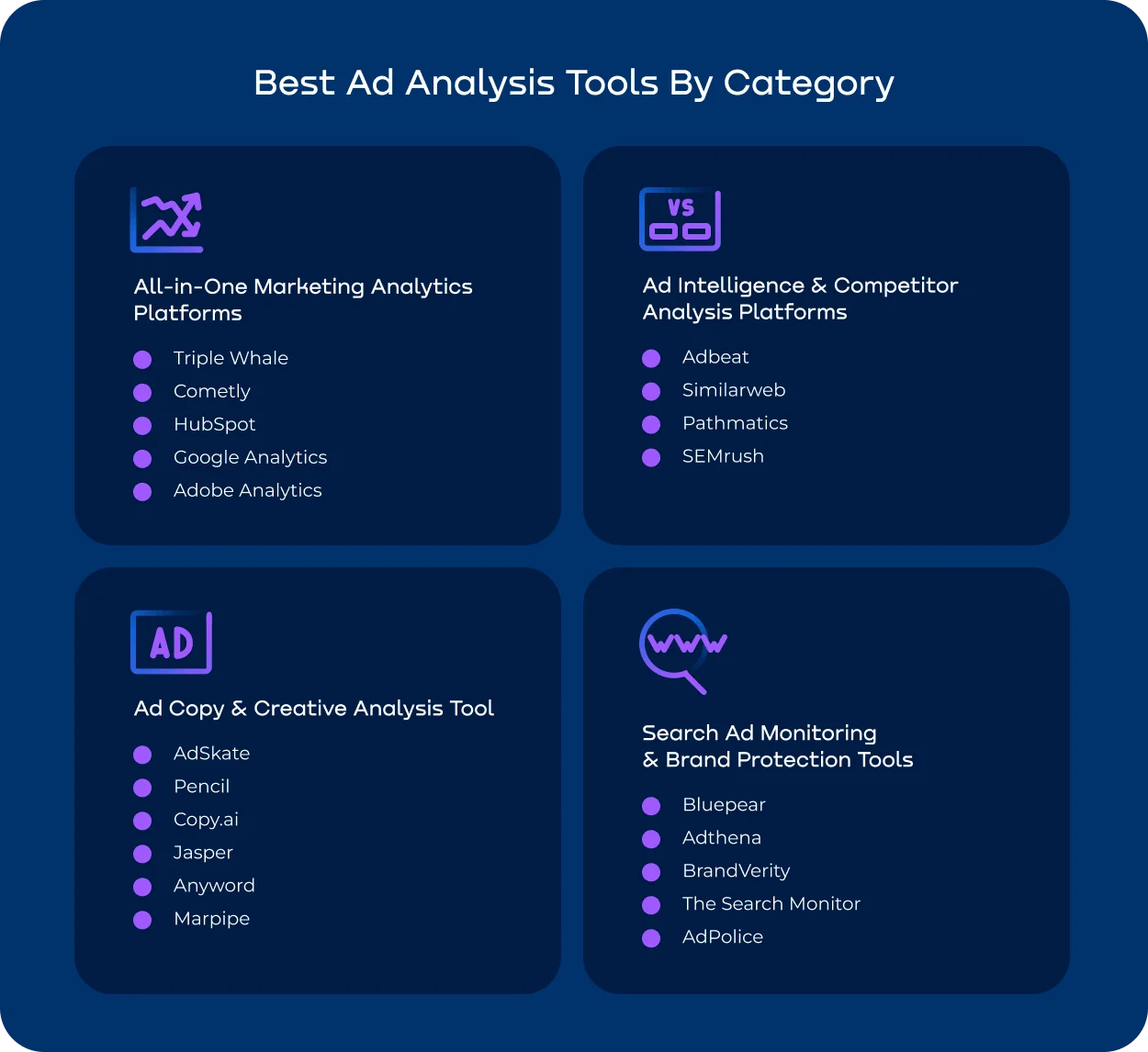
Below is an overview of frequently recommended platforms for ad analysis. We based our choice of tools and the summaries for this article after consulting industry reviews, software comparison aggregators, and discussions on forums, LinkedIn, and Reddit.
The table below provides a quick positioning overview of the platforms covered in this guide. The detailed sections below explain where each platform fits best and where limitations may appear.
| Tool | Main Focus | Choose It If... | Probably Not Ideal If... |
|---|---|---|---|
| HubSpot | CRM-driven marketing analytics | You want advertising and sales data in one ecosystem | You need highly specialized PPC intelligence |
| Triple Whale | Ecommerce attribution | You run a Shopify or DTC-focused brand | You operate outside ecommerce workflows |
| Cometly | Real-time attribution analytics | You actively optimize paid media performance | You prefer lightweight reporting setups |
| Similarweb | Market and competitor benchmarking | You need visibility into broader traffic trends | You need more exact PPC or spend-level accuracy |
| Adbeat | Display ad intelligence | You monitor competitor display campaigns | Paid search visibility is your main concern |
| AdClarity | Cross-channel ad intelligence | You want broader market visibility across channels | You need campaign execution or attribution tools |
| Pathmatics | Creative and media intelligence | Competitive creative monitoring matters to your strategy | You need SMB-friendly pricing or simplicity |
| AdSkate | AI-assisted creative analysis | You test large volumes of ad creatives | You expect predictive scoring to replace testing |
| Pencil | AI creative generation | Your team rapidly produces paid social creatives | You need deep competitive intelligence features |
| Bluepear | Search ad monitoring & brand protection | You need visibility into brand bidding or ad hijacking | You primarily need conversion analytics |
| BrandVerity | Compliance-focused search monitoring | Affiliate compliance and trademark protection are priorities | You need broader marketing analytics capabilities |
Multifunctional Marketing Analytics Tools
The services in this category gather analytical data from multiple channels and offer more depth or additional functionality.
HubSpot
HubSpot has both ad analysis tools and CRM functionality with a heavy focus on customer lifecycle visibility.
What it does:
-
• Tracks leads and user interactions across the funnel
-
• Connects advertising activity with CRM and sales information
-
• Centralizes reporting, contact management, and lead tracking
We recommend it for:
-
• B2B organizations
-
• Inbound-focused marketing teams
-
• Companies aligning sales and advertising workflows
Limitations:
-
• Advanced analytics available only in higher-tier plans
-
• Less specialized for advanced PPC intelligence
Triple Whale
Triple Whale is designed mainly for ecommerce businesses managing several advertising channels.
What it does:
-
• Monitors performance across platforms
-
• Connects advertising performance with revenue metrics
-
• Adds attribution insights and visibility into cross-channel activity
We recommend it for:
-
• Shopify brands
-
• DTC ecommerce companies
Limitations:
-
• Primarily tailored to ecommerce workflows and less useful for B2B
-
• Advanced reporting may require onboarding time
Cometly
Cometly centers around attribution tracking and real-time paid media analytics. Often used as an ad analysis tool, helping teams better understand campaign effectiveness across platforms.
What it does:
-
• Tracks attribution across advertising channels
-
• Monitors ROAS and CPA
-
• Delivers real-time AI-assisted analytics
-
• Helps analyze attribution paths across touchpoints
We recommend it for:
-
• Performance teams
-
• Agencies managing paid campaigns
Limitations:
-
• Attribution accuracy depends on tracking setup
-
• Analytics depth feel excessive for simpler workflows
Similarweb
Similarweb is primarily used by SEO and marketing departments for competitor research or market benchmarking. While it is not built as an ad analysis tool centered around paid advertising, many marketers use it alongside ad intelligence platforms.
What it does:
-
• Shows estimated traffic and acquisition sources
-
• Monitors engagement and behavioral trends on a website
-
• Offers benchmarking and market visibility insights
We recommend it for:
-
• Companies in competitive industries
-
• Enterprise teams
Limitations:
-
• Not specifically built for PPC monitoring or attribution
-
• Traffic and spend estimates are directional, not exact
-
• Smaller websites may have limited data accuracy
Ad Intelligence Platforms
Unlike traditional analytics platforms that focus primarily on internal campaign performance, ad intelligence tools help teams monitor marketing trends in the broader market.
Adbeat
Adbeat is a digital ad intelligence tool intended for competitive advertising research.
What it does:
-
• Tracks competitor display advertising activity
-
• Reveals competitor ad placements and traffic sources
-
• Analyzes display advertising activity
We recommend it for:
-
• Media buyers
-
• Competitive research teams
Limitations:
-
• Less focused on paid search monitoring
-
• Estimates are directional, not exact
-
• Interface may feel data-heavy for inexperienced users
AdClarity
AdClarity is a digital ad intelligence platform frequently used alongside ad analysis tools to track competitor advertising visibility across marketing channels.
What it does:
-
• Detects activity in display, video, mobile, and social marketing channels
-
• Estimates media spend and publisher distribution
-
• Monitors advertiser share of voice
-
• Gives additional insights into competitor advertising activity
We recommend it for:
-
• Enterprise marketing teams
-
• Companies looking for multi-channel ad intelligence
Limitations:
-
• Primarily oriented toward enterprise-level use cases
-
• More focused on market intelligence than campaign execution
-
• Ad spend data should be treated as approximations rather than exact figures
Pathmatics
Pathmatics specializes in advertising intelligence across advertising environments like social, display, and others.
What it does:
-
• Shows creatives from competitor ads
-
• Estimates media spend
-
• Monitors campaign activity in several marketing channels
-
• Surfaces messaging trends and ad placement activity
We recommend it for:
-
• Creative strategy teams
-
• Enterprise advertisers
-
• Agencies managing competitive verticals
Limitations:
-
• Primarily enterprise-oriented
-
• Historical depth varies by channel
Creative and Ad Copy Analysis Tools
The marketing analytics tools in this category can be used for reviewing, testing, and improving ad messaging and creatives.
AdSkate
AdSkate focuses heavily on AI-assisted creative analysis and effectiveness prediction.
What it does:
-
• Analyzes ad creatives
-
• Provides AI-assisted creative scoring and performance analysis
-
• Identifies messaging patterns
-
• Tracks engagement signals across assets
We recommend it for:
-
• Paid social teams
-
• Brands producing high volumes of creatives
Limitations:
-
• Predictive models are probabilistic
-
• Requires ongoing creative testing to maximize value
Pencil
Pencil combines AI-assisted creative generation with performance-oriented recommendations.
What it does:
-
• Generates ad creative variations with AI
-
• Suggests creative and messaging variations
We recommend it for:
-
• Fast-moving paid social teams
-
• Creative-heavy ecommerce brands
Limitations:
-
• Generated creatives require human review
-
• Less focused on competitive analysis
Search Ad Monitoring & Brand Protection Tools
These platforms focus on paid search monitoring, affiliate compliance, brand bidding detection, and ad hijacking prevention. Instead of measuring campaign performance, these ad analysis tools monitor the search environment.
Bluepear
Bluepear helps brands detect unauthorized advertising activity that can increase acquisition costs or divert branded traffic.
What it does:
-
• Monitors brand keywords in search engines
-
• Detects brand bidding and ad hijacking
-
• Tracks affiliate PPC activity and potential policy violations
-
• Monitors competitor ads appearing on branded search queries
-
• Captures SERP screenshots
We recommend it for:
-
• Companies protecting trademarked search traffic
-
• PPC managers and compliance teams
Limitations:
-
• Designed primarily for branded keywords monitoring and compliance workflows
-
• Not meant to give additional performance insights
Right now Bluepear provides a 7-day free trial for all new users. Sign up to track competitor brand bidding in Google, Bing, and other paid search platforms free of charge.

BrandVerity
BrandVerity specializes in compliance monitoring and trademark protection across paid search environments.
What it does:
-
• Detects affiliate policy violations
-
• Monitors trademark bidding activity
-
• Tracks potentially misleading search ads and affiliate violations
We recommend it for:
-
• Affiliate and PPC teams
-
• Compliance-sensitive brands
Limitations:
-
• More specialized in compliance monitoring than marketing analytics tools
-
• Not made to provide attribution and ad effectiveness analytics
Final Thoughts: Building a Complete Ad Intelligence Stack
There is no single tool that solves every advertising visibility problem perfectly.
Some ad analysis tools specialize in paid media analytics, others — in competitor research, creative performance analysis, or brand monitoring. For a modern brand utilizing several marketing channels, relying on a single dashboard is increasingly risky.
Today, marketing teams combine multiple platforms into a full ad intelligence stack tailored to their particular needs and risks. A common stack can include:
-
• Marketing analytics tools
-
• Ad intelligence tools
-
• Ad copy analysis tools
-
• Compliance software
The more complete the visibility becomes, the easier it is to formulate confident strategic decisions before performance issues become expensive problems.
FAQ
What separates marketing analytics tools from ad intelligence platforms?
Marketing analytics tools are primarily built to measure the performance of your own advertising campaigns. These platforms typically track metrics like conversions, customer acquisition costs, attribution paths, engagement, and return on ad spend. Their role is to help teams optimize campaigns based on internal business data.
Ad intelligence solutions focus more on the external advertising landscape. They help companies research competitor marketing activity, such as their search and display placements. The tools can also identify market trends, helping teams understand how other brands position their messaging across channels.
Which tools are recommended for competitor ad monitoring?
Many marketing teams rely on platforms such as Similarweb, Pathmatics, Adbeat, and AdClarity for competitive analysis. These tools are commonly used to get digital ads intelligence, analyze traffic and acquisition sources, display placements, messaging patterns, and detect notable signs of shifts in marketing strategy.
Can ad analysis tools detect brand bidding or affiliate abuse?
Generally, the advertising platforms rarely provide dedicated compliance monitoring capabilities. Detecting issues like trademark bidding, coupon abuse, or ad hijacking typically requires specialized monitoring systems built specifically for brand protection workflows.
For example, you can test Bluepear for free right now. This tool provides automated tracking for PPC brand bidding and offers transparent scalable pricing.
How can smaller businesses choose an ad analysis tool without overspending?
Smaller teams usually get better results by prioritizing tools that solve a specific operational problem instead of purchasing large all-in-one suites immediately. For some businesses, that may mean focusing on attribution reporting first. Others may benefit more from competitor tracking, creative analysis, or search visibility monitoring depending on where their biggest blind spots exist.
Choosing narrowly focused tools often reduces unnecessary costs while still improving campaign visibility and decision-making.
Are AI-powered ad copy analysis tools accurate enough for creative optimization and decision-making?
AI-driven advertising platforms can be very useful for identifying trends in messaging, detecting creative fatigue, clustering high-performing variations, and accelerating large-scale ad testing. They are especially valuable for teams managing hundreds or thousands of ad assets simultaneously.
That said, AI systems are usually most effective when paired with human oversight. Strategic positioning, audience psychology, tone, and brand context still require interpretation that automated systems cannot fully replicate on their own.

See Who’s Bidding on Your Brand