
Contents
AI Max is Google’s latest solution for ad campaign automation. The feature gives Google more room to decide which searches should trigger an ad, drawing on campaign settings and assets. For marketers, that can mean reaching people they might not have targeted manually.
But for brands running affiliate programs, broader targeting raises a compliance concern.
Many programs prohibit affiliates from bidding on branded search terms. So what happens when an affiliate launches a generic campaign and Google AI Max matches it to a branded search? Could an affiliate breach program rules without deliberately adding the prohibited terms as keywords? And how to tell such an accident from intentional brand bidding? Read on to explore the topic.
What Is Google AI Max, and How Does It Work?
AI Max is a PPC advertising optimization layer that was introduced by Google with the goal of helping advertisers reach relevant searches that traditional keyword targeting might miss. It works in existing Google Search campaigns, automating how ads are matched, worded, and delivered. It uses existing keywords alongside ad assets and LP content to identify additional searches that may be relevant.
AI Max core mechanisms:
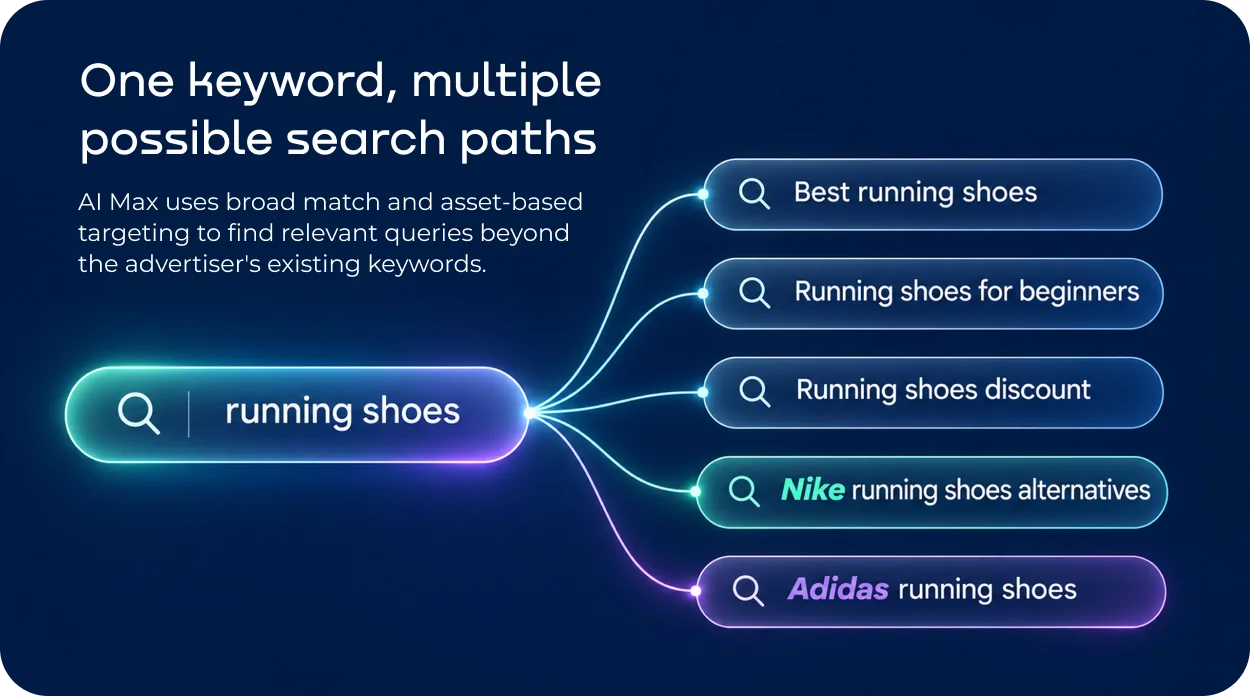
- • Search term matching. Google AI utilizes broad match, asset-based signals, and keywordless technology to find relevant searches beyond the advertiser's existing keywords. The system considers campaign keywords, ad content, and landing pages when deciding which queries may fit.
- • Text customization. Google Ads AI can use existing ad copy, website content, and other campaign assets to generate new ads tailored to a user's search.
- • Final URL expansion. When enabled, this feature can use search query and the ad group's theme to send users to a more relevant page on the website rather than the original final URL set by the advertiser.
Reporting has been expanded too: advertisers can review search terms, the source of matches, ad combinations, and the LPs set by the system.
Since September 2026, eligible Search campaigns that use campaign-level Broad Match or Automatically Created Assets have been automatically upgraded to AI Max. Dynamic Search Ads are scheduled to follow in February 2027.
Why Marketers Are Worried About Losing Control of Paid Search Advertising
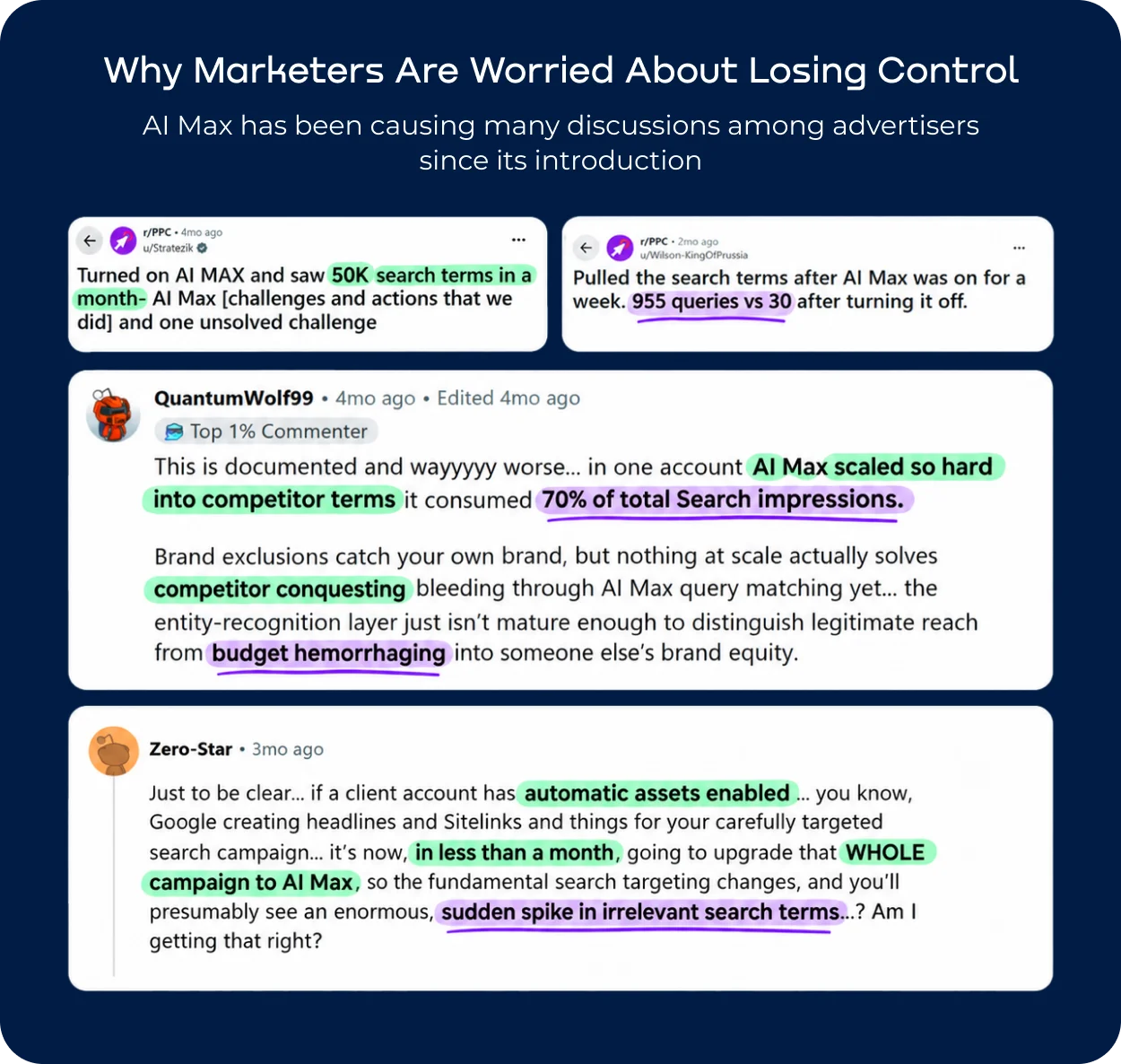
Some PPC specialists have reported a sharp increase in search-term volume after enabling Google AI Max. In a July 6, 2026 discussion on Reddit, one advertiser described seeing around 50,000 new search terms after switching the feature on. They also found that non-brand campaigns were serving ads for branded queries, forcing the team to introduce brand exclusions.
Another advertiser shared a more controlled comparison in an August 31, 2026 post. During one week with AI Max enabled, their campaign generated 955 distinct search queries, and 72% of the reported spend went to searches they considered unrelated to the product. After disabling, the campaign recorded 30 queries — all containing the software brand's name.
These are individual account experiences, not proof that AI Max routinely wastes marketing budget. But they show why the trend for automation makes some advertisers uneasy.
Not every advertiser reports problems, and some find the Google Ads AI features useful. But the practical consequence is clear: marketers need to thoroughly check campaigns to understand what their ads are doing.
What Happens When You Use Google AI Max for Branded Campaigns?
When AI Max is enabled, Google’s algorithms get more flexibility over three parts of ad delivery: which searches trigger the ads, what the ad says, and which pages the click leads to. The exact changes depend on the available signals, settings, and relevance of the search.
The first change happens at the targeting level. Usually, branded ad campaigns rely on a relatively narrow set of keywords: the company and product names, some common variations and typos. Google AI Max can identify and target additional queries based on the campaign's existing keywords, ad assets, and landing pages.
For example, a company running a paid search advertising campaign around its brand name may start reaching searches that combine the brand with product categories, specific features, or other relevant terms. The system can also identify queries that don't contain the exact brand keyword but are considered relevant to the campaign.
Next comes ad customization. With the feature enabled, Google can generate new headlines and descriptions. The wording may change depending on the search query, so users don't necessarily see the exact ad copy the advertiser originally submitted.
Then there's Final URL expansion. When enabled, Google can send users to a different page on the advertiser's website if it considers that page more relevant to their search. Instead of always landing on the homepage or the URL specified in the original ad, a user might be directed to a product, category, or other relevant page.
For advertisers, this raises two concerns: paying for traffic that should have been handled by a separate campaign, and appearing alongside searches they never intended to target.
There is also a risk of overlap between branded and non-branded campaigns. For example, a generic PPC advertising campaign may start capturing searches for the company's name, competing with a dedicated brand campaign and potentially driving up its costs. Google provides brand exclusions to help prevent this kind of cannibalization.
AI Max and Affiliate Compliance: Can Affiliates Violate Brand Bidding Rules Unintentionally?
Many affiliate programs restrict how partners can use the advertiser's trademark in paid search advertising. The rules vary, but common restrictions include bidding on:
- • Exact brand names and domain names.
- • Misspellings, abbreviations, and other brand variations.
- • Brand names combined with product terms, or words such as coupon, discount, and review.
- • Competitor trademarks, where the program explicitly prohibits them.
Some programs go further and prohibit affiliates from using the advertiser's website as a direct landing page for paid ads. Others restrict brand names in ad copy, display URLs, or extensions.
How AI Max Could Create Accidental Brand Bidding
Consider an affiliate promoting a merchant's products through a generic Search campaign.
The affiliate adds commercial keywords such as best project management software or project management tools for small businesses. They don't manually include the merchant's name.
Then they enable Google AI Max to expand search reach. Google Ads AI uses the campaign's existing keywords, ad creatives, and website content to identify additional relevant searches. If a query containing the merchant's brand name is considered relevant to that campaign, the affiliate's ad may become eligible to appear for it — even though nobody manually added the branded query to the keyword list.
How Likely Is This Scenario?
This is a plausible scenario, not an automatic consequence of enabling AI Max. Whether it happens depends on the campaign context and matching signals.
Still, Google explicitly describes AI Max as a tool for expanding matching beyond the advertiser's existing keywords. It also provides brand exclusions for cases where advertisers need to prevent their ads from appearing alongside particular brands.
To conclude, brand-related matching is a possibility, but Google gives advertisers tools to manage it.
Can You Tell Accidental Brand Bidding From Intentional Violations?
For affiliate compliance, three situations need to be considered separately:
- • Deliberate targeting: An affiliate manually adds a prohibited brand term to a campaign. This is a clear targeting choice and may directly breach the program rules.
- • Automated matching: Google AI Max matches an ad to a branded search query the affiliate never added as a keyword.
- • Failure to act: The affiliate discovers that branded queries are triggering ads but doesn’t take steps to prevent further matches.
The first step is to ask the partner for evidence. An AI Max search terms report can reveal the actual query that triggered the ad and help identify the matching source. Campaign settings, keyword lists, negative keywords, brand exclusions, and change history can provide further context. Together, these records can help establish whether the brand term was added manually or matched through AI for Google Ads.
If the partner cannot provide this information, the reason for the branded match remains unverified. That alone doesn't prove deliberate misconduct. But that is where the partner's response becomes especially relevant. Did they exclude the branded queries, adjust campaign settings, or pause the problematic ads? Or did the same activity continue after they were notified? Tracking what happens after the affiliate was notified of the problem may require access to specialized tools.
How to Detect Brand Bidding and Protect Affiliate Programs
With Google AI Max expanding search term matching, an ad may appear even if the affiliate's original keyword list contains no trademark terms. To investigate, affiliate managers need visibility into live paid search results.
Bluepear is a brand bidding monitoring tool that helps teams monitor branded search activity and collect evidence for further investigation. It checks paid search results across Google, Bing, and Yandex, covering 200+ locations, different languages, devices, and time zones.
Bluepear doesn't automatically stop ads or decide whether an affiliate acted intentionally. It gives teams the evidence to investigate suspicious activity, compare it with program rules, and follow up with the partner.
For agencies and freelancers managing several PPC advertising accounts, this also means less time spent manually checking branded searches across every client and market.
You can test Bluepear with a free trial. No credit card required. It's a practical way to see what branded ads are actually appearing across your active projects.
Conclusion: Can Affiliates Unintentionally Violate Brand Bidding Rules Because of AI Max?
It is possible. Affiliates can appear for prohibited branded searches without manually including brand names in their keyword lists. Google AI Max expands matching beyond explicitly selected keywords, so a generic ad campaign may potentially reach brand-related queries. But this isn't always the outcome of enabling the feature. It depends on the campaign setup and available signals.
As AI for Google Ads takes on more of the targeting work, affiliate compliance needs to look beyond declared keywords. Monitor the ads that actually appear, check where they lead, and keep evidence of suspicious activity.
FAQ
Can Google AI Max trigger ads for branded search terms?
Yes. Google AI Max can match ads to branded search queries even when an advertiser hasn't added those brand names as keywords. Whether a branded query triggers an ad depends on campaign settings, relevance signals, and brand controls.
How can affiliate managers detect brand bidding in Google Ads?
Affiliate managers can combine search term analysis with PPC advertising monitoring. Google Ads reports help identify which queries triggered an affiliate's ads, while external monitoring tools show what users actually see across different search engines, locations, and devices. Bluepear collects ad copy, landing page details, screenshots, timestamps, and redirect information to help teams investigate and document potential violations.
Can negative keywords prevent AI Max from matching branded searches?
Negative keywords can help exclude unwanted branded queries from a campaign. Advertisers can also use Google Ads brand exclusions where appropriate. However, these settings need to be reviewed and maintained as campaigns evolve, or if the advertised product goes through changes AI for Google Ads wouldn’t be aware of. Affiliate managers should routinely verify actual search results.
Does AI Max automatically target competitor brand names?
No. Google AI Max doesn't automatically target every competitor or related brand. Its matching depends on campaign context and relevance signals. Google also provides brand inclusions and exclusions to help advertisers control which brand-related searches can trigger their ads.

Brand bidding detection — free trial