

Contents
In 2026 a customer can ask ChatGPT or any other AI how two products compare or whether a particular company is reliable. Adobe’s research found that consumers already actively use AI assistants for shopping research (53%), product recommendations (40%), and finding deals (36%). At Bluepear, we specialize in brand monitoring, which is why in this article we’re looking at AI search monitoring as a new layer of brand visibility.
AI Visibility Tools
A good AI visibility tracker should turn AI search results into measurable signals. At base level, it should show whether your brand is shown in response to relevant customer questions and how it is presented. If you're choosing AI visibility tools, the table we prepared should provide a quick way to compare them.
| Tool | Capabilities | Best suited to |
|---|---|---|
| Profound | Useful for teams that need broad AI-search and AI-agent intelligence rather than simple mention tracking | Enterprise SEO specialists, AI search teams |
| Semrush AI Visibility Toolkit | Helps SEO and marketing teams connect AI visibility with existing search data and measure changes over time | SEO specialists, digital marketers |
| Ahrefs Brand Radar | Useful when you want AI visibility tied to real search demand and existing SEO research | SEO specialists, content teams, brand marketers |
| OtterlyAI | A monitoring-focused option for teams that primarily need recurring checks of brand and competitor presence | Brand monitoring specialists, marketers |
| Scrunch | Useful for brands interested in both how they appear in AI answers and how AI agents interact with their business | Growth teams, brand marketers |
| AthenaHQ | Particularly relevant when the main concern is how accurately AI represents the brand | Brand managers, reputation teams |
| Conductor Intelligence | Fits larger marketing organizations that want AI visibility data alongside broader enterprise marketing analytics | Enterprise SEO specialists, marketing teams |
| Peec AI | Strong option when benchmarking competitors and tracking changes in visibility are the main priorities | AI search analysts, SEO specialists |
| SE Ranking SE Visible | Convenient for teams that already use rank-tracking workflows and want to add AI visibility without a separate monitoring stack | SEO specialists, agencies, SMB marketing teams |
| ZipTie | Combines monitoring with recommendations that can help SEO and GEO teams investigate visibility gaps | SEO specialists, GEO teams |
| LLMclicks.ai | Useful when the priority is checking whether AI-generated representations of the brand are accurate and supported by appropriate sources | Brand monitoring specialists, reputation teams |
| Omnia | Continuous monitoring and alerts make it suitable for teams that need to react quickly to changes rather than review data periodically | Marketing teams, growth teams, brand managers |
Feature sets and coverage change quickly as Al search visibility tracking tools evolve. Current product documentation confirms that major platforms increasingly combine multiple LLMs.
AI Search Monitoring vs. Traditional Search Monitoring
Just as Al does not replace traditional search, Al brand monitoring should not replace classic brand monitoring. Let's explain why.
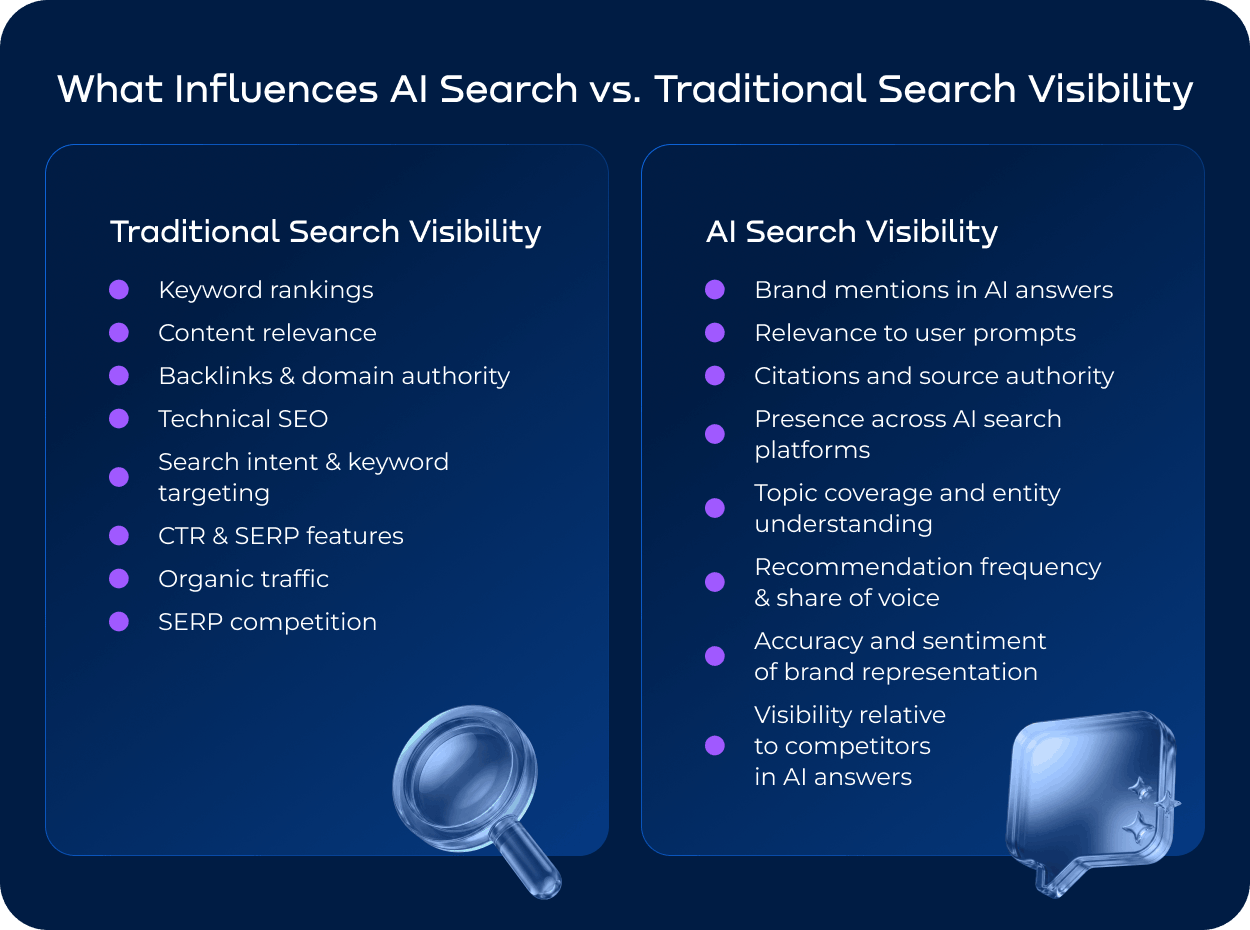
Traditional Brand Monitoring
Traditional brand monitoring typically follows identifiable placements and signals:
-
• Branded keywords and SERP results;
-
• Paid ads appearing for branded queries;
-
• Affiliate and partner placements;
-
• Third-party mentions and reviews;
-
• Competitor presence around branded or category searches.
These signals remain valuable. They show how customers can encounter your brand and who else is competing for that visibility.
To learn more about traditional search monitoring services, read our article on the topic.
What Changes with Al Search?
Al-generated answers introduce a layer where there may be no single page, ad, or fixed position to monitor. An Al system decides which brands to mention, how to describe them, which products to recommend, which competitors to compare, and which sources to cite.
It can also produce an inaccurate or outdated representation of a product or a company. Or show a completely different answer to a similar prompt later.
That changes the object of monitoring. Rather than monitoring placements, teams track the representation of their brand within LLM answers. That is what differentiates Al brand monitoring.
How to Use AI Search Monitoring
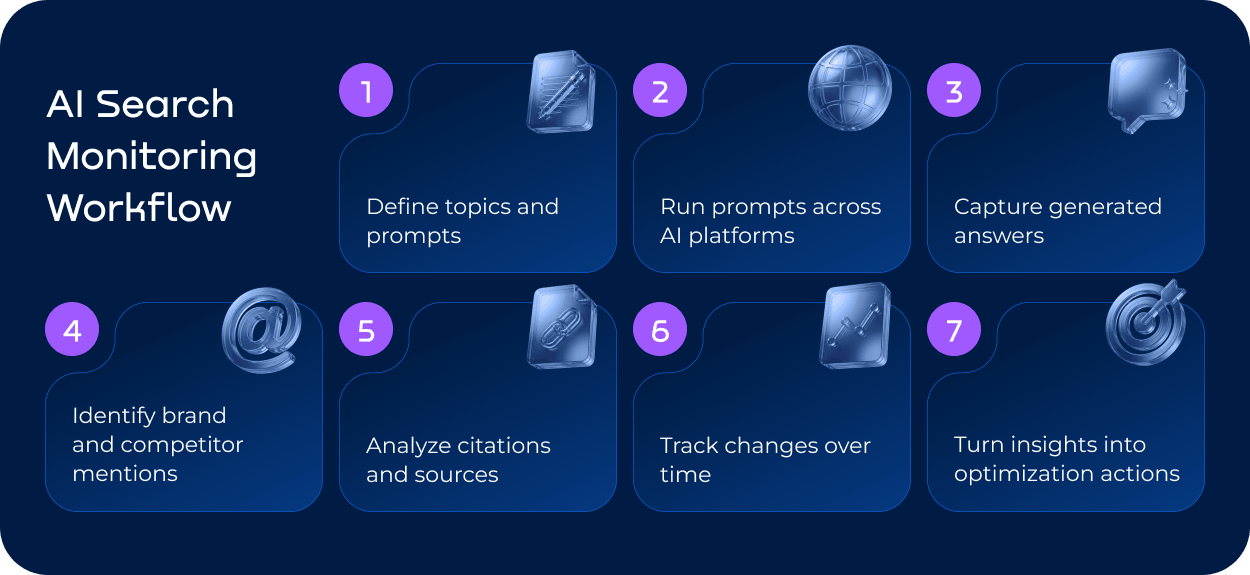
The core workflow is similar in purpose — define what matters, collect observations, compare them, and track changes.
However, Al search is less predictable than a keyword-based SERP. A customer may express the same intent through several prompts, each producing a different set of brands and sources.
A useful monitoring set might therefore include:
-
• Topic clusters covering the categories and relevant use cases;
-
• Variations of the same customer question;
-
• Prompts targeting different stages of the buying journey;
-
• Queries for comparison and alternatives;
-
• Location-specific questions where market differences matter.
Form a set of questions that reflects how your target audience is likely to discover and evaluate your brand. Monitor comparable prompts in several Al search surfaces. Different Al systems may select different sources, mention different competitors, or frame the product in different ways. Even within one platform, results may change as models, sources, indexes, and retrieval systems change.
What Should Brands Monitor in Al Search?
Look at Al search monitoring as these six connected layers:
1. Presence: Is the Brand Getting Mentioned?
Start with the most basic signal: Al mentions.
Check whether Al engines bring up your brand for questions a potential customer could ask when researching a product, comparing providers, or deciding what to buy. Run monitoring for prompts that include your brand name, category ("What is the best X?"), or the specific problem your product solves.
2. Position: Where Does the Brand Appear?
Next, measure the brand's position within the answer. Is it the first recommendation, one of several alternatives, or merely mentioned in passing? Does the Al system recommend it directly, or only include it when comparing competitors?
3. Context: How Is the Brand Represented?
This layer of AI brand monitoring can be especially useful for reputation teams.
It allows tracking the context of mentions:
-
• Sentiment;
-
• Product and service descriptions;
-
• Claims about pricing, features, or performance;
-
• Outdated or factually incorrect information;
-
• Recommendations that could affect purchase decisions.
4. Sources: Where Does AI Get Its Information?
The answer an LLM generates may rely on websites, reviews, product pages, or other sources.
AI citations can reveal which domains influence the way a company is represented. This is why checking the cited URLs is useful when an answer contains inaccurate information: the source might explain where that information came from.
5. Competition: Who Appears Instead?
If your company disappears from a category prompt while three others are being recommended consistently, that’s a competitive signal.
Monitor competitor visibility with AI visibility tools. This shows who’s capturing the potential demand that could otherwise belong to you.
6. Change: How Does Visibility Move?
Historical trends that some AI visibility trackers provide might reveal gradual shifts such as a drop in citations, a growing competitor presence, or a change in sentiment.
Why AI Visibility Data Is Harder to Measure
Traditional search gives marketers a relatively stable framework for measuring brand visibility. If a page ranks #3 for a keyword, that position can be tracked over time and compared with competitors.
AI search works differently. The model itself, retrieval process, location, timing, available sources, and even small changes in phrasing can influence the final answer. A brand may be mentioned in one answer, omitted from the next, or cited through a different source.
A 2026 study accepted to ACM SIGIR analyzed 11,500 user search queries in Google. AI Overviews appeared for 51.5% of the queries, while their sources differed substantially from the traditional Google results, with an average Jaccard similarity below 0.2. The researchers also found that AIOs were less consistent in repeated runs and after minor changes to the query.
That inconsistency is what makes AI visibility so hard to evaluate. Therefore, in case of AI search monitoring, reliable measurement requires teams to consistently track prompts and collect historical data. Only that way they can confidently assess whether their brand visibility in LLMs is persistent — and see what influences it.
How AI Search Monitoring Fits Into Brand Management
From a marketing perspective, LLMs are now another place where customers encounter product information, evaluate providers, and form opinions. That makes AI tracking important to several teams at once.
SEO and Content
AI search monitoring can show the domains that repeatedly serve as sources for generated answers.
For SEO teams, that gives additional perspective on content relevance and overall domain authority.
Content teams can review citations to find gaps that may point to missing topics, weak supporting content, or landing pages that do not provide information AI systems can interpret.
Reputation and Compliance
Sometimes LLMs can generate answers using outdated, incomplete, inaccurate, or negative information about a brand. Citations can help ORM and compliance specialists find the source of misleading product descriptions, incorrect claims, unauthorized associations, or problematic third-party materials.
AI search monitoring tools usually do not determine whether a particular statement creates legal liability. Their role is to surface potentially problematic representations, so that the appropriate teams can investigate them.
Competitive Intelligence
AI visibility trackers can be used to reveal who appears in the answers that could’ve mentioned your brand instead.
Use it to determine which competitors repeatedly appear for commercially important prompts. Analyze and compare share of voice, and see which sources may be driving their advantage.
Building an AI-Aware Brand Monitoring Framework
For a brand team, visibility in AI search is another discovery surface alongside traditional search results, paid ads, affiliate placements, and other sources.
A practical framework can bring these signals together.
Layer 1 — Traditional Search
Start with the surfaces most marketers already track: organic rankings and paid results. These show whether customers can find the brand through conventional search and whether competitors or unauthorized advertisers are competing for branded demand.
If you want to learn more about search engine monitoring, read our article on the topic.
Layer 2 — Affiliate & Partner Ecosystem
This next layer covers the partner ecosystem around the brand. Affiliate PPC, coupon catalogues, redirects, and unauthorized placements can greatly influence what customers see before they reach the official website.
A brand that has strong visibility in search might still be losing conversions to partners who compete for branded traffic. This can lead to wasted spend and lost revenue for both PPC and affiliate teams. To avoid that, we recommend using our tool — Bluepear. It continuously checks paid and organic search results, highlighting affiliate compliance issues and collecting evidence for enforcement. Give Bluepear a try — a free trial period is available to all new users.

Layer 3 — Web and Brand Mentions
Reviewing the content on third-party websites adds context that search rankings alone cannot provide. Reviews, comparison pages, publishers, forums, and other external sources can shape how customers perceive a certain brand.
Focus on more than just the volume of mentions. Monitor where those mentions appear and the claims they contain.
For more information on brand keyword monitoring, read our article.
Layer 4 — AI Search
Use AI search visibility tracking tools to monitor answers across major LLMs.
This layer provides more value when connected to other signals rather than in another isolated dashboard. A competitor cited frequently by AI may also be dominating comparison content. A third-party source repeatedly cited by LLMs may deserve closer review. An affiliate or paid placement may explain why customers encounter a different brand before reaching the official site.
Conclusion: Brand Monitoring Has Expanded
With the appearance of AI the definition of brand visibility is expanding. Now, brand teams ask:
-
• Where does my brand appear?
-
• Who recommends it?
-
• What is said about it?
-
• Which sources support that representation?
-
• Who appears instead?
-
• Is that picture changing over time?
AI brand monitoring gives affiliate, reputation, marketing, and compliance teams another way to analyze what potential customers encounter when they search for a product or a brand.
FAQ
How is AI search monitoring different from traditional brand monitoring?
Traditional monitoring primarily tracks brand-related keywords across external sources. Meanwhile, AI search monitoring focuses on AI-generated answers and citations.
In practice, the two approaches complement each other. A source identified through traditional means may also become an important source for improving AI visibility. And vice versa.
Which AI search engines should brands monitor?
Most established AI visibility tools cover all the major AI search engines.
These platforms are worth monitoring because of their scale. For example, ChatGPT reached 1 billion monthly active users in June 2026, while Google reported more than 1 billion monthly active users for both the Gemini app and AI Mode. Google also says AI Overviews reach more than 2.5 billion users each month.
This does not mean every brand needs identical coverage. The right mix depends on which AI experiences are available in your target markets.
Can AI Brand Monitoring help identify inaccurate brand information?
Yes. An AI visibility tracker can help surface inaccurate or outdated product descriptions, claims, pricing, features, or associations through citations.
These findings can be reviewed by the appropriate marketing, reputation, legal, or compliance team. AI search monitoring does not replace that review. Its value is in making potentially problematic representations visible before they become difficult to track across a growing number of AI search experiences.

Check if Your Competitors Bid on Your Brand