

Contents
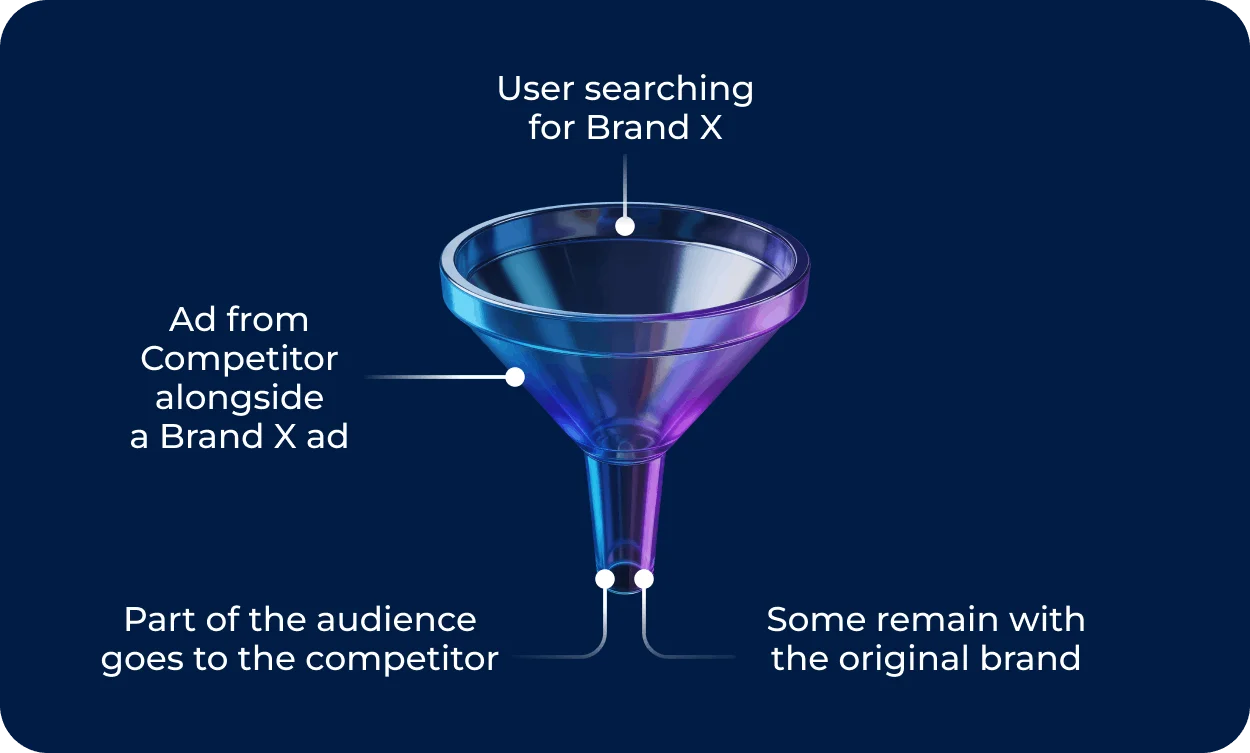
In this guide, we are exploring a paid search strategy where advertisers target keywords that include a rival company’s name. It is commonly known as competitive brand bidding or brand targeting.
It is often used in highly competitive markets such as SaaS, finance, and e-commerce. The end goal is positioning your offer in front of the audiences searching for a specific competitor, rather than waiting for them to discover your brand organically.
Read this guide to PPC bidding on your competitor's brand, if you want to know how to bid on brand keywords to:
-
• Capture decision-stage users
-
• Increase market share
-
• Expand beyond generic keywords
-
• Position your product as an alternative to popular brands
Why are Advertisers Bidding on Competitor Brand Keywords
The core motivation behind bidding on competitor brand terms is simple: traditional acquisition channels are extremely saturated. As CPCs increase across non-branded search, advertisers look for more efficient entry points where user intent is already clearly defined. Brand targeting introduces new keyword inventory and provides a way to avoid direct competition on broad, high-volume terms.
Another reason to bid on brand keywords is intent capture. Brand searches typically represent some of the strongest commercial intent. Consumers are searching for a solution they already know. From a performance perspective, this means shorter conversion cycles compared to non-branded keyword traffic and clearer user needs at the point of search.
A significant portion of bidding on competitor’s brand name in PPC is tailored to the comparison phase. Advertisers aim to influence decision-making and shift preference away from the company that users originally searched.
Is PPC Bidding on Your Competitor’s Brand Really Effective?
Brand targeting is not a universally applicable strategy. It tends to deliver strong results only under specific conditions:
-
1. Strong alternative: Brand bidding works best when the advertiser offers a clearly viable alternative. Users are more open to exploring alternatives when the advantages are obvious and the perceived risk of switching is low.
-
2. Clear differentiators: Effectiveness increases significantly when there is a strong and visible differentiation point. For example, lower pricing, superior features, niche specialization, or better service.
-
3. Mature PPC setup: A mature PPC account has segmented campaigns for branded and non-branded traffic and controlled bidding strategies with defined CPC limits. Without this level of structure, bidding on competitor brand terms can quickly lead to inefficient spend and unclear attribution.
In practice, advertiser success depends less on the act of targeting competitor traffic and more on how precisely the entire acquisition system is built around it.
Insights from PPC Practitioners (What Marketers Say)
While the tactic is widely used by advertisers, discussions about PPC bidding on your competitor's brand keywords reveal a split perspective.
A recurring theme across PPC communities is that brand bidding campaigns can perform well in saturated markets, because consumers actively explore alternatives. In these cases, bidding on competitor’s brand name in PPC can bring incremental traffic that would otherwise be difficult to reach through generic keywords alone.
However, many marketers also note that success is not consistent. Without a clear value proposition or strong differentiation, traffic quality tends to decline. Consumers searching for a specific brand are usually already committed, which reduces conversion probability even if CTR remains high. A common observation from practitioners summarizes this dynamic clearly: “You’ll get clicks, but not always the right ones.” From that stems another common issue: low return on investment.
Retaliation is also frequently mentioned as a structural risk. Once you begin to bid on brand keywords, it’s likely to trigger reciprocal behavior, which can result in escalating costs on both sides without meaningful performance gains. And if the targeted company uses a brand bidding monitoring tool, you’re looking at an almost immediate response — don’t believe it? Try Bluepear for free to see how it works.
The overall consensus is that success of brand bidding tactics is very conditional.
Is PPC Bidding on Your Competitor’s Brand Legal?
Across the US, EU, Canada, and related jurisdictions, the legal consensus is relatively stable:
-
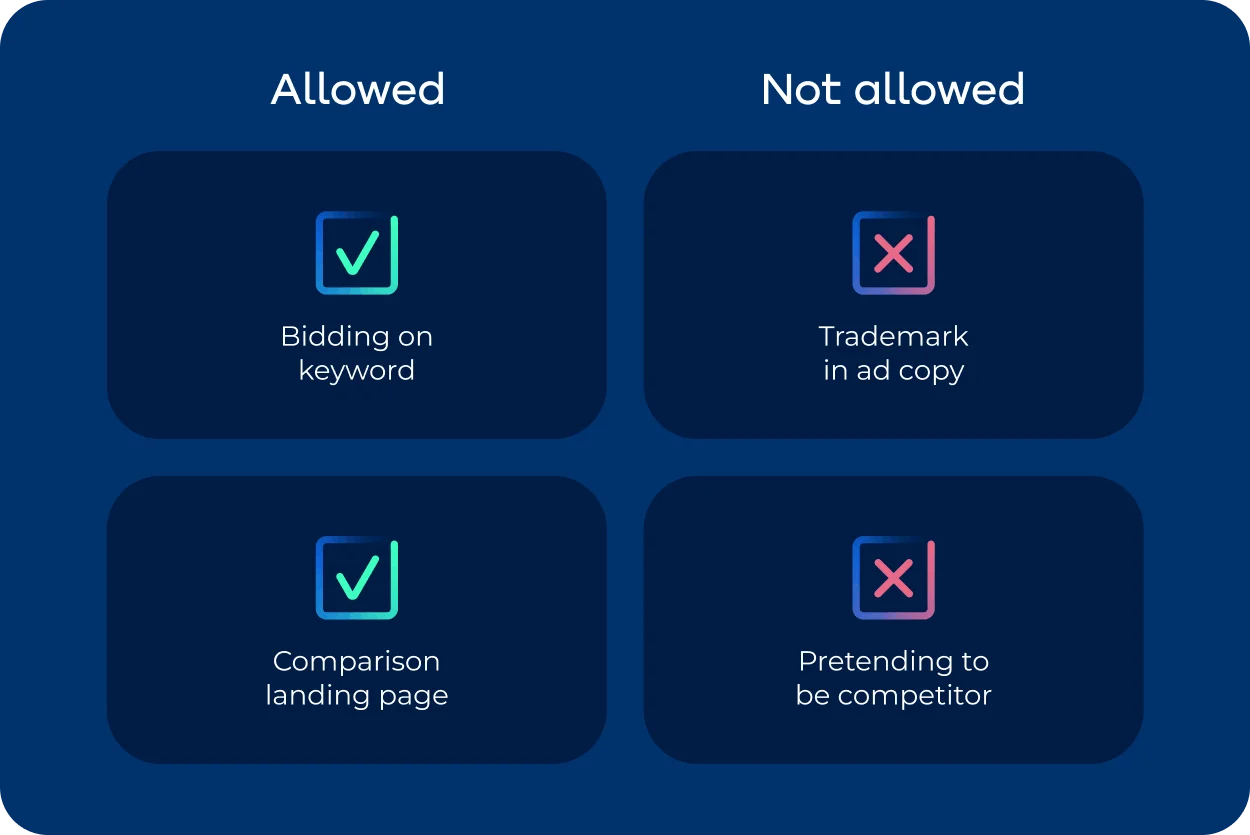
• Bidding on competitor’s brand name in PPC is generally legal
-
• Liability does not arise from bidding itself
-
• Legal risk appears only when ads create confusion or misrepresentation
In the United States, the legal foundation is primarily built on the Lanham Act (15 U.S.C. § 1114 & § 1125). This law protects registered trademarks and prohibits unauthorized use that is likely to cause consumer confusion.
A key legal mechanism applied in these cases is the “Likelihood of Confusion” standard, which courts use to evaluate whether an average user might believe there is an affiliation between two companies. Factors include:
-
• Whether the competitor’s brand appears in ad copy
-
• How clearly the brand bidding competitors distinguish itself
-
• Whether the overall presentation could mislead users about the source of the product or service
In the European Union, trademark enforcement is governed by the EU Trade Mark Regulation (EUTMR) (Regulation (EU) 2017/1001). The framework is similar in principle but places stronger emphasis on the “origin function” of a trademark — meaning whether users can clearly identify the commercial source of goods or services.
The general rule is consistent: advertisers are allowed to bid on brand search terms, but they are restricted in how they present themselves in ad text. This is where most legal disputes arise.
The Real Risks of Bidding on Competitors’ Brand Name in PPC
Even though it is not forbidden from the legal perspective, PPC bidding on your competitor's brand introduces certain structural risks.
The most visible downside is a low Quality Score. Paid search advertising platforms evaluate relevance based on ad text, keyword intent alignment, and landing page consistency. When marketers bid on brand keywords of another company, they operate outside the most relevant semantic context. This leads to reduced ad relevance scores due to intent mismatch.
When an ad competes for a branded query it does not own, the auction system often compensates through higher cost per click requirements to maintain SERP quality. Because of this, brand bidding competitors typically require bigger budgets to achieve similar visibility levels.
Another consistent challenge in PPC bidding on your competitor's brand is the quality of incoming traffic. Consumers who search for a specific brand often have predefined expectations, prior experience, or a recommendation. This significantly reduces flexibility in decision-making and often comes with a low willingness to switch without a compelling reason.
In the end, even though bidding on competitor brand terms generates clicks, those clicks may not actually translate into conversions. This is why many advertisers experience strong CTR but weaker downstream performance.
How to Bid on Brand in PPC: Step-by-Step Competitive PPC Bidding Strategy
You need a smart strategic approach to PPC bidding on your competitor's brand to avoid inefficient spend and stay in control of performance.
Unlike standard keyword campaigns, bidding on competitor brand names requires tighter segmentation, clearer messaging, and more deliberate control over user intent pathways.
Step 1 — Identify Competitor Brand Keywords
The first stage is building a clear and realistic keyword map. This step defines the scope of competitive targeting and prevents wasted spend.
First, build a list of brands to target. Include direct competitors offering the same product to the same audience. Then expand the list to product-level alternatives — solutions that address the same user need, even if they differ in approach, features, or positioning.
Then, compile a keyword list that reflects how consumers actually search when they are close to choosing a product:
-
- Basic list of brand names and brand + product combinations
-
- Comparison and evaluation queries — “[Competitor] alternative”, “[Competitor] vs [your brand or others]”, etc.
-
- Intent modifiers — brand + “pricing”, brand + “reviews”
Exclude navigational queries like “Competitor login” or “Competitor support”. These are usually searched by loyal audiences already using the company’s products, meaning near zero chance of converting to an alternative.
Step 2 — Structure Campaigns Properly
When it comes to PPC bidding on your competitor's brand, campaign structure directly affects both cost and clarity of results. If everything sits in one campaign, you won’t understand what’s working and what’s not.
So here are some tips on how to structure:
-
1. Separate your own brand: Your branded campaigns and bidding on competitor brand terms are serving different purposes and working with different intents. The separation is needed to measure the real effectiveness of both.
-
2. Split campaigns: Create separate campaigns for each targeted competitor. Inside each of them divide ad groups into core brand keywords, comparison queries, and alternatives. This gives you the ability to pause underperforming segments without killing everything.
-
3. Prevent keyword overlap with negatives: Add your brand name as a negative in the campaigns targeting the competition and competitor keywords as negatives in your own branded campaign.
Step 3 — Set a Bidding Strategy
Once structure is defined, the next goal is selecting an appropriate bidding model.
Manual bidding allows:
-
• Tighter control over initial CPC levels
-
• Controlled testing of segments
-
• Reduced risk of overspending on unproven keywords
On the other hand, automated bidding can scale faster but may lack precision when entering new keyword segments where historical conversion data is limited.
When bidding on a competitor's brand name in PPC, advertisers are recommended to start with controlled manual bidding. Once performance patterns stabilize, it is safe to transition to automation.
Step 4 — Write Compliant, High-Converting Ads
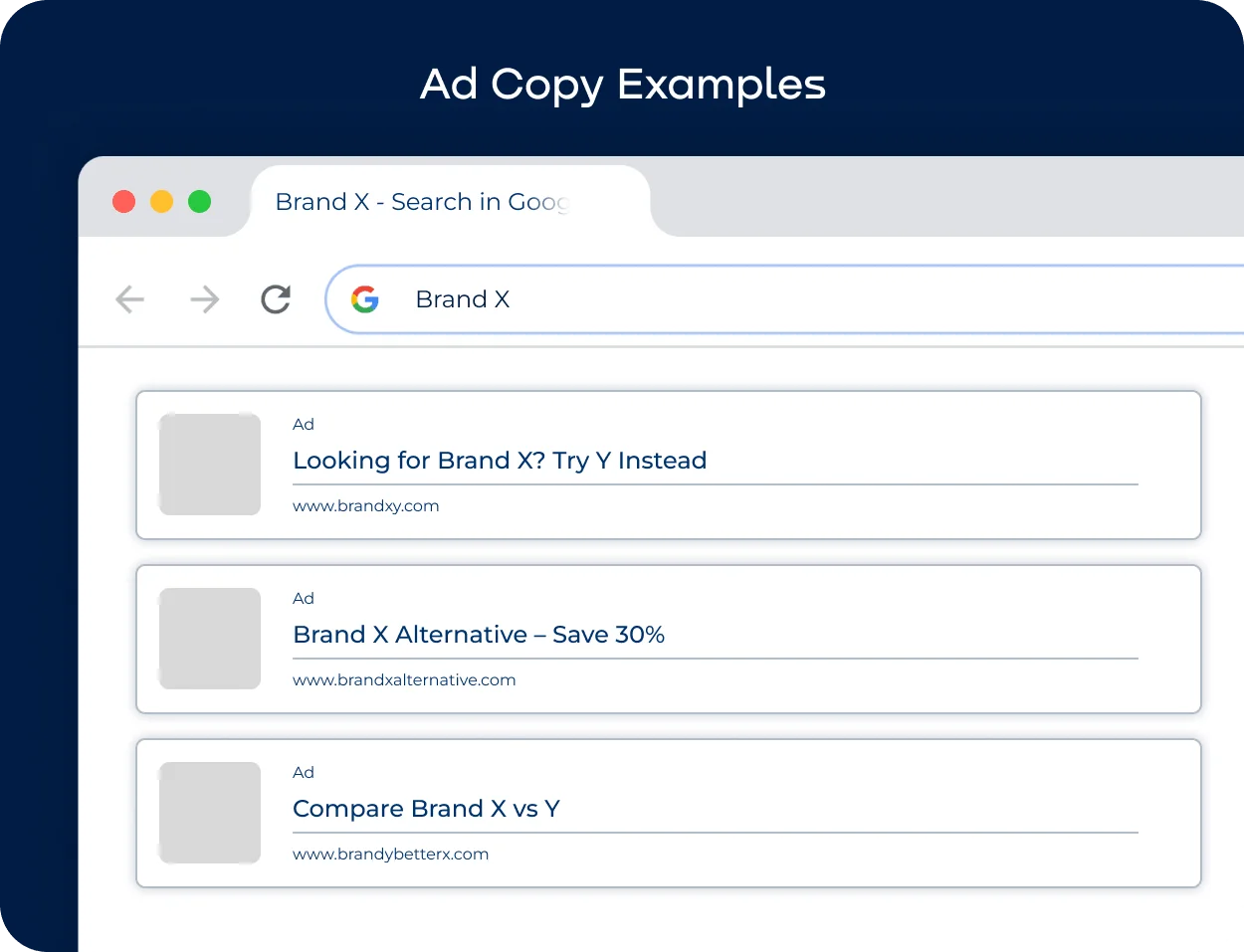
Ad text plays a significant role in determining whether PPC bidding on your competitor's brand brings you meaningful traffic or wasted clicks. Messaging also affects whether your advertising can be perceived as misleading.
To remain compliant:
- • Avoid trademark misuse or misleading references
- • Ensure no implication of official affiliation with the competitor
- • Maintain clear differentiation in messaging
Avoid misrepresentation. Focus on direct comparisons and positioning as an alternative solution. Highlight unique value propositions such as pricing, speed, or special features. The real goal here is to provide a clear reason for consumers to reconsider their initial search intent.
Step 5 — Optimize Landing Pages
Landing page alignment can be the deciding factor in whether PPC bidding on your competitor's brand succeeds or fails. Even strong ads can underperform if the post-click experience does not match user expectations.
Users coming from bidding on a competitor's brand name in PPC behave differently from generic traffic. They already have a specific solution in mind. So the goal is not to present your product the same way you would in a classic advertising scenario — it’s to reframe the consumers decision.
-
1. Don’t use generic pages: If a user lands on a generic product page, they have to do extra work to understand why they should switch from the solution they already settled on. Most won’t. Create dedicated landing pages for the brand bidding campaigns.
-
2. Align message with keyword intent: Make sure that consumers find the information their queries imply an interest in: comparisons, pricing, product reviews, etc.
-
3. Acknowledge the brand bidding competitors' context: Users should immediately understand where they are and how your page relates to the brand they originally searched for. Misleading messaging not only creates legal risk — it also destroys trust.
-
4. Make differentiation obvious: Effective pages clearly highlight what you do better, who you are better for, and why switching makes sense.
-
5. Remove friction from switching: Switching cost — real or perceived — creates a barrier. Your landing page should reduce it by highlighting easy migration or onboarding. Provide demos, trials, or guarantees. Explain how users can transition from the competing product to yours.
When You Should NOT Engage in Bidding on Competitor Brand Terms
Understanding when not to use brand targeting strategies is just as important as knowing how to execute them.
The main telling signs that you should not engage in bidding on competitor’s brand name in PPC:
-
• Early-stage product: It is not recommended to bid on brand during early market entry stages. Consumers considering mature brands are usually less likely to switch to an unfamiliar or unproven alternative, which often leads to inefficient acquisition costs.
-
• Weak positioning: Another critical limitation appears when the product lacks a clear differentiation point. Without a strong value proposition, bidding on competitor brand keywords often results in high click volume but low downstream performance. In such cases, users may explore the offer but rarely complete conversion actions.
-
• Limited budget: Budget constraints significantly impact the sustainability of brand targeting strategies. These auctions are typically more expensive due to high commercial intent and strong competition for visibility. Underfunded campaigns often fail to reach meaningful performance thresholds.
Ultimately, brand bidding is most effective when it is part of a structured ecosystem rather than an isolated tactic. Without timing, positioning, and budget alignment, the strategy tends to shift from opportunity into inefficiency.
How to Defend Your Own Brand from Brand Bidding Competitors
PPC bidding on your competitor's brand is rarely a one-way activity. Once advertisers begin targeting competitor traffic, it is almost inevitable that their own branded keywords become a target in return. This creates a continuous exchange within paid search ecosystems where brand bidding competitors directly influence visibility and budget spend.
To respond strategically, you need to understand:
-
• Who exactly is bidding on your brand
-
• How they position themselves against your offer
-
• Whether their messaging changes over time
-
• What they emphasize — price, features, comparisons, etc.
In many cases, advertisers bidding on a competitor's brand name in PPC test angles, highlight specific value propositions, and sometimes become more aggressive if they see traction. If you don’t track these changes, you’re reacting blindly.
This is why the first layer of defense is visibility into competitor activity.
If you’re a smaller brand with limited exposure, manual checks can be enough. But this approach breaks down quickly as complexity grows. For larger brands, manual monitoring becomes unreliable because:
-
• SERPs vary by location, device, and time
-
• Multiple competitors may rotate ads
-
• Messaging changes frequently
-
• Internal teams don’t have time to track this consistently
At scale, monitoring requires automation. Competitor analysis tools like Bluepear are designed to help marketers track their brand bidding competitors across markets. If you're looking for a tool that can fit right in with a mature PPC setup — sign up with Bluepear, it only takes up to 5 minutes.
Key Takeaways on PPC Bidding on Competitor’s Brand
The viability of PPC bidding on your competitor's brand is not defined by the strategy itself, but by how precisely it is executed within a broader acquisition system. Across industries, bidding on a competitor's brand name in PPC can produce strong results in some scenarios while underperforming in others, depending on positioning, budget discipline, and competitive context.
At its core, brand bidding sits in a high-intent but high-friction environment, as user loyalty and expectations are already shaped. This makes outcomes highly sensitive to execution quality rather than the mere presence of PPC bidding activity.
As a result, bidding on brands must be evaluated within specific market conditions rather than treated as a general best practice.
FAQ
Is PPC bidding on your competitor’s brand worth it for small businesses?
For smaller teams, this tactic can become expensive quickly if there’s no clear differentiation or budget for testing. In many cases, it makes more sense to first stabilize core acquisition channels before expanding into competitor targeting. However, in niche markets with limited competition, it can still deliver value if executed carefully.
How long does it take to see results from bidding on a competing brand?
Initial signals like impressions and clicks appear almost immediately, but meaningful performance insights usually take a few weeks. Early data should be treated as directional rather than final, especially when testing new competitors or messaging angles.
Does brand bidding work in affiliate marketing?
Brand bidding in affiliate marketing sits in a gray zone and is often restricted. Many brands explicitly prohibit partners from targeting branded keywords to avoid internal competition and inflated acquisition costs. Violating these rules can lead to commission loss or removal from the program.
The key is to always check program terms before launching campaigns. Even if the tactic is technically allowed, it’s important to avoid misleading messaging or positioning that could create confusion.

Find Out Who’s Bidding on Your Brand