
Contents
Many advertisers first notice brand bidding when CPC on their brand keywords suddenly increases because someone is competing for them. In other cases, the trigger is even more direct: searching for your own brand reveals that competitors are now showing in paid results. That moment raises immediate questions, especially if you were not actively engaging in bidding on competitor brand strategies yourself.
Is it actually allowed? And most importantly — what is the right response? Should you increase bids, adjust your campaigns, or take a more formal approach if someone tries to bid on trademark terms in a misleading way?
At Bluepear, we monitor brand bidding activity across multiple markets on a daily basis. In our experience, the right approach depends on who is behind the activity and how they are using your trademark keywords.
In this guide, we break down how brand bidding competitors operate, when buying competitor keywords is considered acceptable, when it becomes a violation, and how to respond effectively.
Why Competitors Target Your Brand Keywords
Targeting another company’s branded terms is widely known as brand bidding. In practical terms, it means entering paid search auctions for queries that include a competitor’s name. This approach is a deliberate tactic where advertisers engage in bidding on competitor brand terms to position their offer directly in front of users who already have intent.
Buying competitor keywords has become a standard tactic across industries. It allows advertisers to intercept demand at a late stage of the funnel and compete for attention when it matters most. In highly competitive markets, this form of competitor conquesting is no longer occasional — it is systematic. In fact, it is so common that, according to Lunio, 93% of agencies run branded PPC campaigns to protect their client’s brand demand. That also answers the question: “Why bid on your own brand terms?” — for many marketers, it is an integral part of a brand protection strategy.
There are several reasons why brand bidding competitors actively pursue this strategy:
- 1. Capturing high-intent users: A search that includes a brand name usually signals strong intent. Users are evaluating options or preparing to make a purchase. By appearing in these results, brand bidding competitors aim to redirect that intent.
- 2. Lower acquisition costs: Though it is not always guaranteed, some advertisers find that buying competitor keywords allows them to generate conversions without investing heavily in awareness campaigns. Instead of building demand, they redirect it.
- 3. Increased visibility: Even when users don’t click, appearing alongside a well-known brand increases exposure. Over time, this can position a competitor as a viable alternative, especially in crowded markets.
The logic behind this strategy becomes clearer when you look at performance. Branded traffic behaves differently from generic traffic. It typically delivers stronger engagement, higher conversion rates, and more predictable returns.
While exact numbers vary by industry and funnel stage, aggregated benchmarks consistently highlight the performance gap between branded and non-branded campaigns. For example, here’s data published LuminixAI in February 2026:
| Metric | Branded | Non-Branded |
|---|---|---|
| CPC | ~$2 | ~$20 |
| Conversion Rate | 55% | 38% |
| Cost Per Lead | $72 | $149 |
| Avg Budget Split | 18% | 82% |
Because branded campaigns tend to deliver some of the strongest results in paid search, it’s no surprise that brand bidding has become more widespread. As more advertisers recognize the value of high-intent traffic, competitors bidding on brand name queries is no longer an exception — it’s part of how modern auctions operate. In many industries, buying competitor keywords is now a standard layer within broader competitor conquesting strategies.
Is Bidding on Competitor Brand Keywords Allowed in Google Ads?
The short answer is yes. From the platform’s perspective, targeting trademark keywords at the keyword level is permitted, which is why this practice is so common across markets.
At the same time, there are clear boundaries. While you can bid on trademark terms as keywords, how those trademarks are used in ads is tightly controlled. Google restricts the use of competitor brand names in ad copy.
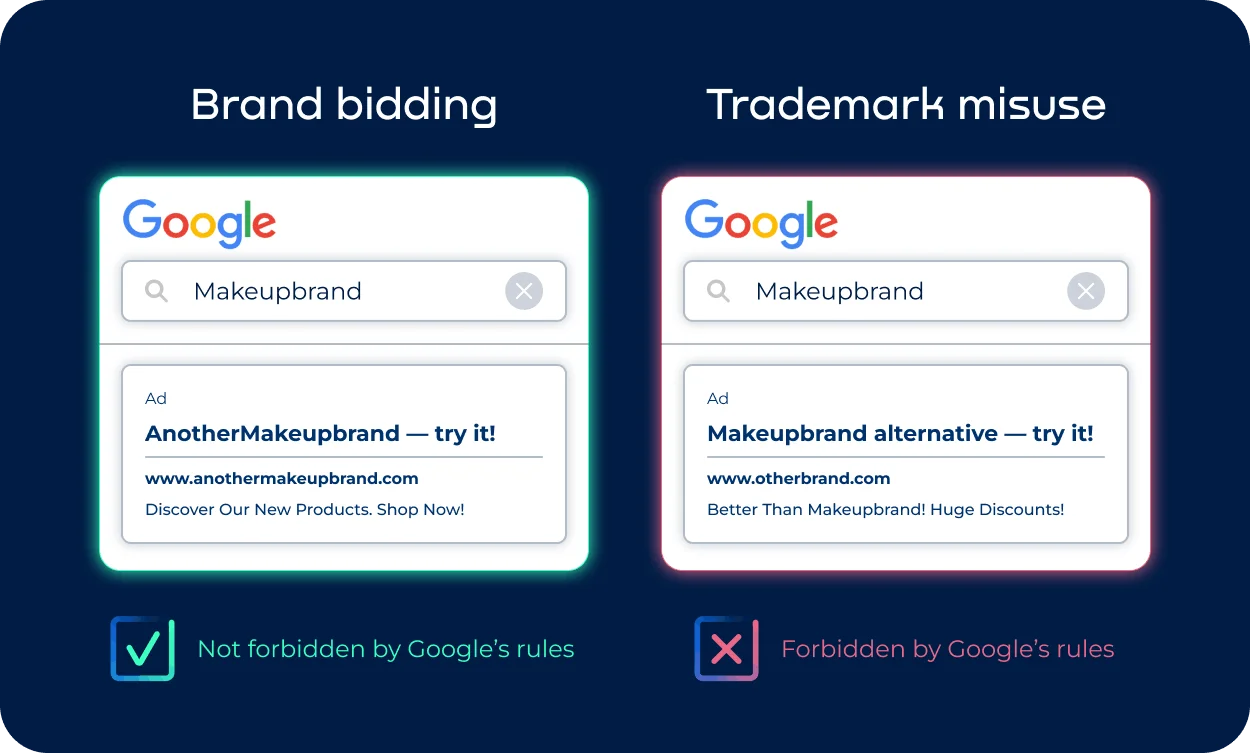
This distinction is critical. Buying competitor keywords is about accessing the auction and competing for placement. Using those same terms in ad copy or landing pages can imply endorsement, partnership, or official status — and constitute trademark infringement.
Violations of these policies can lead to ad disapprovals, restricted delivery, or full removal following a trademark complaint.
What’s also important to understand is that Google does not automatically detect and block every instance of misuse. Instead, much of the system relies on complaints submitted by trademark owners. That means brands need to take an active role in monitoring how their brand keywords are being used, which often requires specialized tools like Bluepear — especially when running several Google Ads accounts. Without a brand protection strategy reinforced by specialized compliance tools, violations can go unnoticed, allowing brand bidding competitors to operate unchecked.
How to Identify Brand Bidding Competitors, Affiliates, and Fraudsters
The impact of brand bidding goes far beyond who appears first in search results. When competitors bidding on brand name queries enter your auctions, CPC increases and impression share declines. Over time, this pressure can distort campaign economics.
To respond effectively, it’s important to recognize that not all auction participants play the same role.
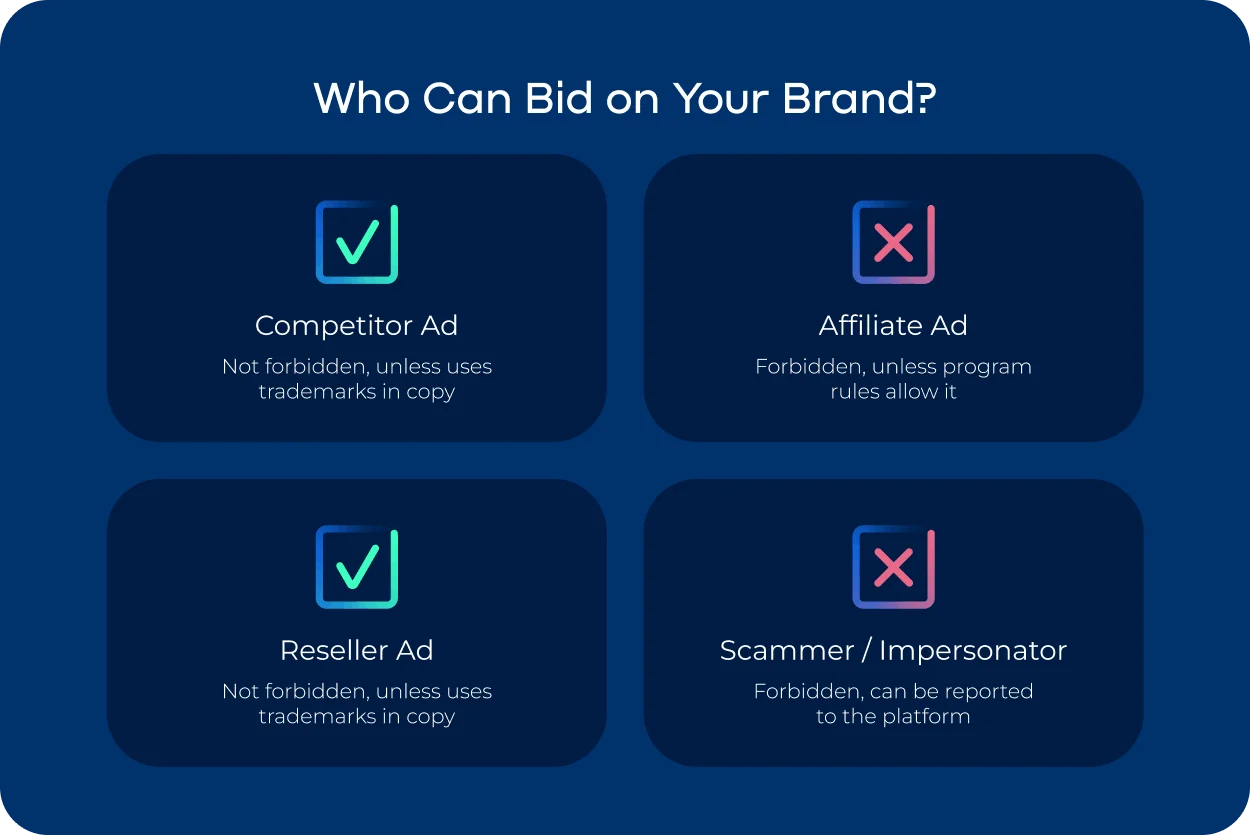
There are four main groups that typically appear in branded auctions:
-
1. Competing businesses — companies operating in the same market.
-
2. Affiliates — partners who may be promoting your products in PPC.
-
3. Resellers — distributors or third parties that advertise your products.
-
4. Impersonators — malicious actors aiming to mislead users.
A case study from mFilterIt illustrates why this distinction matters. A large skincare brand noticed a steady increase in CPC — around 25–30% — across its branded campaigns. At first glance, this looked like standard market competition. However, deeper analysis showed that the brand's own partner networks had entered auctions for the same brand keywords. Once these actors were identified, the brand was able to enforce compliance rules, reduce internal competition, and stabilize campaign performance.
This example highlights a key point: identifying who is behind brand bidding activity determines your next step. Some cases require enforcement, others require campaign adjustments, and some simply need monitoring. Without this clarity, even a strong brand protection strategy can fall short.
Below are three practical methods to identify who is buying branded keywords and targeting your brand demand.
1. Manual Checks in Google Search Results
The simplest way to start is by running manual searches. Enter your brand keywords into Google and review the ads that appear alongside yours. This provides immediate visibility into paid search. However, this approach has clear limitations. It requires time, consistency, and coverage across locations and devices. As your brand grows, so does the number of brand bidding competitors, making manual checks increasingly difficult to scale. What works for a small campaign quickly becomes inefficient for larger accounts or multi-market operations.
2. Google Ads Auction Insights
Google’s built-in paid search competitor analysis tool provides a deeper look into competition in PPC. Auction Insights show which advertisers overlap with your campaigns and how often they appear in the same auctions. Metrics such as impression share, overlap rate, and position above rate help you understand how aggressively others are engaging in competitor conquesting. These insights are essential for adjusting bids, refining campaigns, and aligning your brand protection strategy with actual market behavior.
3. Automated Monitoring
For teams managing multiple campaigns, relying on manual checks and Auction Insights is rarely sufficient. Automated monitoring solutions can track competitors’ paid campaigns in real time.
Platforms like Bluepear can monitor large sets of brand keywords simultaneously, detect unusual patterns, and flag suspicious activity as soon as it appears. This includes identifying affiliates, resellers, or potential impersonators who may be engaging in brand bidding or moving toward trademark infringement.
Integrating automated monitoring into your workflow not only saves time but also adds consistency. In the long run, this strengthens your brand protection strategy, helping you maintain visibility, control costs, and respond quickly to any emerging threats.
If you need to maintain visibility for your branded searches and enforce policies efficiently, add Bluepear to your brand protection strategy.

Action Plan: How to Respond to Someone Bidding on Your Brand Keywords
Not all brand keyword bidding is malicious, but each scenario demands a tailored approach to protect visibility, cost-efficiency, and overall campaign performance.
What You Can Do About Brand Bidding Competitors
Advertisers often confirm that there’s no way to fully stop competitors from brand bidding. What you can do is respond strategically. A proactive approach can minimize lost traffic and maintain control over your branded queries.
Key actions:
-
1. Strategically increase bids on core brand keywords to ensure your ads maintain top positions in auctions. Targeted adjustments help retain dominance even when multiple advertisers compete for the same branded keywords.
-
2. Expand keyword coverage to include variations, common misspellings, and long-tail queries — this also prevents gaps that brand bidding competitors might try to exploit.
-
3. Refine ad messaging and creatives to communicate your brand value clearly. Highlight your unique selling points so users can easily distinguish your offering from others, even when ads from brand bidding competitors appear nearby.
-
4. Leverage ad extensions such as sitelinks, callouts, and structured snippets. Using these features maximizes SERP real estate, increases visibility, and can improve click-through rates, which in turn strengthens ad performance against other advertisers.
Taking these steps can help your brand retain priority in search results, defend against auction encroachment, and safeguard campaign efficiency.
What to Do If an Affiliate Is Bidding on Brand Keywords
When affiliates start competing in your branded auction, they intercept users who were already searching for your brand in Google. This inflates CPC, reduces campaign efficiency, and shifts conversions from your own ads to partner-driven traffic — without generating real growth. For this reason, many companies explicitly restrict or fully prohibit affiliate brand bidding.
When an affiliate starts to bid on trademark terms, the first step is to treat it as a compliance issue rather than a direct attack. Sometimes partners cross the line unintentionally.
The optimal course of action:
-
1. Review the rules of your program: Your policy needs to explicitly state that bidding on brand keywords is not allowed. If the rules on brand bidding are not clearly stated, update your policy. Then notify all of your partners that there’s an update and highlight what changed. Give affiliates at least 24 hours to examine the changes and adjust their ad campaigns. If program rules are clear and don’t need to be updated, proceed to the next step.
-
2. Verify which partner violated the rules: Examine the link they used for the affiliate ID or any other identifiers. Alternatively, a compliance monitoring tool such as Bluepear can automatically detect the ID — a useful feature for large-scale programs.
-
3. Gather evidence: Screenshots, links, landing pages and any other fact that can prove the violation will help you resolve the issue faster.
-
4. Contact the affiliate: Reach out to the partner with evidence and guidance. In many cases, a direct conversation is enough to resolve the issue. If the behavior persists, enforce your policy formally by restricting their access or applying program penalties.
This structured approach helps control internal competition, protect your branded traffic, and prevent hidden pressure on auctions caused by brand bidding.
What to Do If Trademark Infringement or Brand Impersonation is Involved
While bidding on competitor brand keywords is generally permitted, there are scenarios where brand bidding competitors cross legal and ethical boundaries. Actions such as incorporating a trademark into ad copy, misrepresenting affiliation, or mimicking brand messaging enter the territory of trademark infringement. When these violations occur, advertisers can report and request removal of offending campaigns.
Additionally, trademark rights are legally enforced in many jurisdictions. For example, the Lanham Act in the United States, which prohibits false designation of origin and misleading use of trademarks in commerce. In the EU, similar protections are provided under the EU Trademark Regulation (EUTMR) and the Unfair Commercial Practices Directive, both of which address misleading advertising and brand misuse. These statutes offer additional avenues for defending your intellectual property.
Swift and structured action is critical here:
-
1. Document evidence: Capture screenshots of ads, record URLs, and log timestamps to create a reliable record of the violation. Use tools like Bluepear to automate the process and get structured proof for escalation immediately after violations occur.
-
2. Submit a Google trademark complaint: This formal channel allows you to flag the ads and request their removal, ensuring compliance with Google’s policies.
-
3. Escalate through legal channels if necessary: For persistent or large-scale infringement, legal enforcement may be required to stop unauthorized usage.
In practice, many cases are resolved before reaching litigation. A well-prepared cease and desist letter, backed by detailed evidence of trademark infringement or impersonation, is often sufficient to halt unauthorized activity, preserving both your brand reputation and the performance of your paid campaigns.
Bidding on Competitor Brand: Should You Do It Too?
Targeting competitor brand keywords can be an effective way to attract users actively searching for alternative solutions. By strategically bidding on competitor brand terms, advertisers can increase visibility in competitive markets and position their product or service directly against rival offerings in search results. Well-executed campaigns of this kind may generate conversions at a lower cost per acquisition compared to broader prospecting efforts. Additionally, engaging in competitor conquesting allows brands to expand awareness and present their unique value proposition to audiences already evaluating other options.
However, the practice of buying competitor keywords comes with notable challenges:
-
• First, high CPC is common when targeting established brands, which can quickly erode ROI.
-
• Second, aggressively buying competitor keywords can negatively impact quality scores, especially if ad relevance and landing page experience are not optimized.
-
• Finally, it may create brand conflicts — both reputational and legal — if your ads are perceived as misleading.
For many advertisers, investing in your own brand keywords while maintaining a comprehensive brand protection strategy can offer a safer and more sustainable long-term approach. We recommend brands to weigh the potential benefits of bidding on competitor brand terms against the financial, operational, and legal risks involved.
Conclusion
Bidding on competitor brand terms is generally permitted under Google Ads policies, but it introduces multiple complexities for protecting your branded keywords, controlling CPC, and maintaining visibility.
The most effective approach involves a brand keyword monitoring strategy. By identifying the type of advertiser and applying targeted strategies to each scenario, brands can reduce lost traffic, address risks of trademark infringement, and respond proactively to brand bidding competitors.
Utilizing automated monitoring and alerting tools, such as Bluepear, allows businesses to detect emerging threats early, enabling timely interventions while preserving overall campaign performance.
FAQ
Are competitors allowed to bid on trademark terms in Google Ads?
Yes. Google permits buying competitor keywords, including trademark keywords, provided these terms are used in keyword targeting and not directly in ad copy.
Is bidding on competitor brand keywords legal?
Yes, it is legal to bid on competitor brand keywords. However, incorporating a competitor’s brand name into ad text in a misleading way can trigger claims of trademark infringement.
Are affiliates allowed to bid on brand keywords in PPC?
It depends on the affiliate program policies. Affiliates must follow program rules, and any unauthorized bidding on brand keywords can be addressed through enforcement measures as part of a broader brand protection strategy.
How to stop brand bidding competitors?
You cannot fully prevent competitors from buying your branded keywords. What you can do is defend your traffic by reinforcing your own branded campaigns, optimizing ad messaging and extensions, monitoring for unauthorized activity, and filing trademark infringement complaints when appropriate. These steps, combined with vigilant oversight of brand bidding competitors Google Ads activity, help preserve campaign efficiency and protect brand equity.

Collect evidence for enforcement with Bluepear