
Contents
Users can find information on brands in many places online: search results, paid ads, review pages, social platforms, marketplaces, and increasingly, AI reviews. Each layer creates different risks and requires a different way to track what is happening.
So that is why there is rarely one tool that can monitor brand mentions in every relevant channel equally well. SERM teams care about reviews, marketers track search visibility, while affiliate managers need evidence of policy violations.
Here, we break down brand monitoring tools by these visibility layers to help in-house specialists and marketing agencies build a stack of software that fits their actual needs.
Every Online Brand Monitoring Mentioned
Use the table below as a quick map: it shows each tool’s primary focus, adjacent capabilities, and the teams it is best suited for. Using it, you can pen down ideas for a brand monitoring software stack that’s built around the visibility layers that are actually valuable to your business model.
| Tool | Primary layer | Secondary coverage | Team fit |
|---|---|---|---|
| Meltwater | Media & social listening | Reputation, sentiment, social analytics | PR, Comms, Marketing |
| Talkwalker | Media & social listening | Social intelligence, sentiment, audience insights | PR, Comms, Marketing |
| Mention | Media & social listening | Social listening, competitor mentions | Marketing, Social, PR |
| Birdeye | Reviews & online reputation | Sentiment, customer experience, response management | SERM, CX, Marketing |
| Podium | Reviews & online reputation | Customer messaging, review generation, response workflows | CX, Support, SERM |
| Reputation | Reviews & online reputation | Sentiment, surveys, customer experience | SERM, CX, Multi-location Marketing |
| Semrush | Organic search & SERPs | Competitor visibility, AI search visibility, paid search intelligence | SEO, Marketing, Content |
| Ahrefs | Organic search & SERPs | Competitor research, backlinks, content analysis | SEO, Content, Marketing |
| Google Search Console | Organic search & SERPs | Search performance, indexing, branded queries | SEO, Marketing |
| Bluepear | Paid search & affiliate compliance | Brand bidding, ad hijacking, coupon monitoring, redirects, evidence | PPC, Affiliate, Compliance, Legal |
| Semrush AI Visibility Toolkit | AI search | AI visibility, mentions, competitor tracking | SEO, Marketing, Content |
| Profound | AI search | AI answers, citations, prompts, competitive intelligence | Enterprise SEO, Marketing, Content |
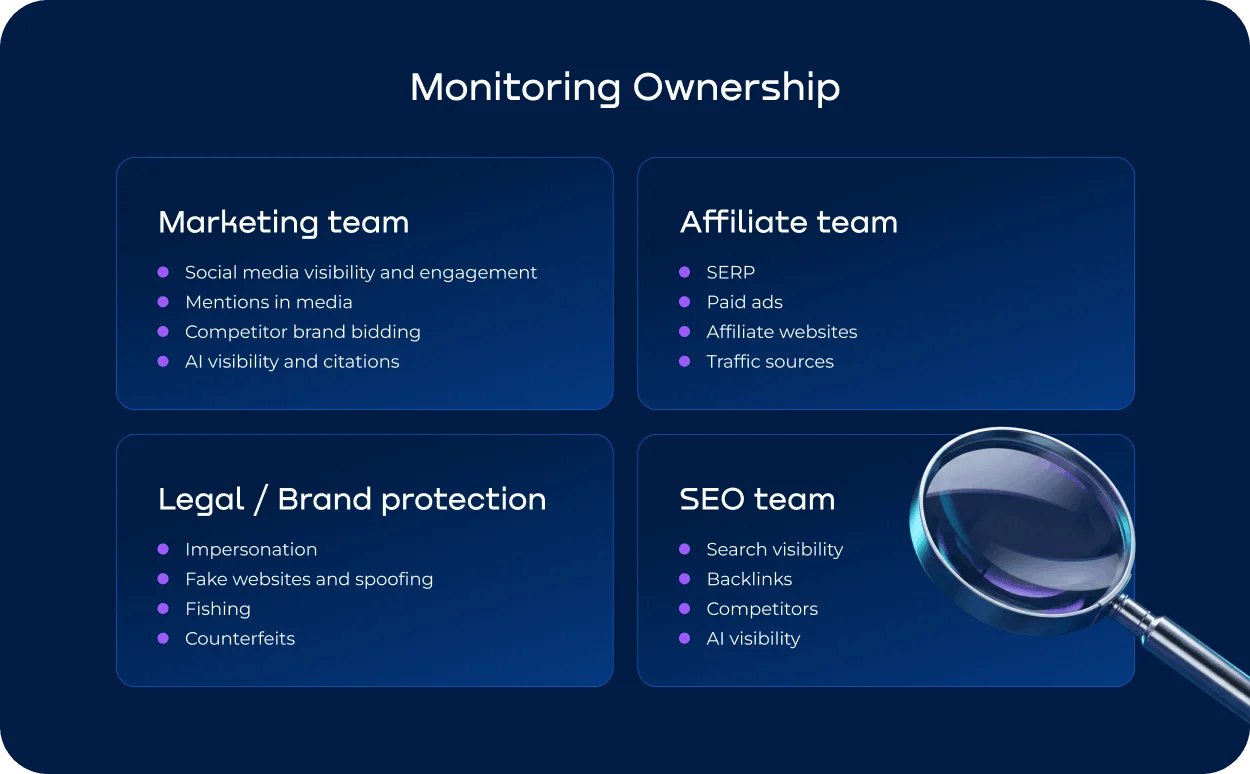
Keep reading if you want to understand how certain teams may benefit from these tools and see what users praise them for ↓
Brand Monitoring Tools for Media and Social Listening
These tools give teams visibility into brand-related discussions across forums, social media, and other public channels.
For PR and communications teams, this layer is about managing reputation and public narratives. Special software can flag a new story about the company or a product, helping the team assess whether it requires a response. It can also reveal when a small complaint or story starts gaining traction across multiple sources — often before it reaches mainstream media.
For social teams, the value is in seeing conversations that are easy to miss when relying on notifications and tagged posts alone. People discuss products without tagging the brand or using different names or misspellings. Listening monitoring brings these conversations into view, helping to identify recurring complaints, emerging customer needs, and reactions to campaigns.
Legal teams and brand protection specialists may use mentions as investigation leads for impersonation cases, misleading claims, or unauthorized brand use.
The brand monitoring software recommended by practitioners is:
-
1. Meltwater — valued by PR and communications professionals for its broad media coverage and reporting, with some experienced users also pointing to its user-friendly interface and ability to surface relevant coverage.
-
2. Talkwalker — praised by users for its easy-to-use interface, responsive account support, and the depth of insights it provides from large volumes of social and media data.
-
3. Mention — appreciated by smaller teams for straightforward cross-channel monitoring, with users commonly mentioning it alongside other accessible tools.
Brand Monitoring Tools for Reviews and Online Reputation
Reviews provide a somewhat different kind of visibility. Google reviews, Trustpilot, G2, and other platforms show what customers think about the actual experience with a company — and whether that experience is becoming a pattern. This is where reputation management software comes in. It collects reviews, flags negative feedback, and helps in organising responses instead of checking every page manually.
For SERM and customer satisfaction teams, tracking recurring topics in customer feedback is often more useful than reading individual reviews. If customers repeatedly mention slow delivery, poor support, or a specific product issue, the signal can go beyond reputation management and reach operations, product, or customer support. Ratings also provide a metric that teams can track.
Marketing specialists benefit from customer feedback when they need to identify reputation gaps against competitors.
The best brand monitoring software for this layer:
-
• Birdeye — stands out for bringing reviews from different platforms and locations into a single workspace. Users find this particularly useful when a team has to keep track of feedback at scale and respond without jumping between multiple review sites.
-
• Podium — gets positive feedback for making customer communication more direct. Its texting workflows and automated review requests can turn everyday customer interactions into more review opportunities.
-
• Reputation — is often mentioned in the context of multi-location reputation management. Users appreciate having reviews, customer feedback, and reputation data consolidated in one dashboard rather than managed separately for each location or platform.
Brand Monitoring Tools for Organic Search and SERPs
Organic SERP tracking looks reveal the searcher’s point of view, showing what appears when someone searches brand or product names.
Branded search results are often the point where a potential customer forms their final opinion. A competitor appearing for your brand term, a comparison article moving into the top results, or a negative review dominating the first page can become what the user sees before they ever reach your website.
For SEO and marketing specialists, it’s about protecting brand visibility and spotting changes in SERP that deserve investigation. A sudden drop in your own pages may indicate a ranking change, while a new competitor page or negative result can reveal a reputation or acquisition problem rather than a conventional SEO issue.
Competitor monitoring also fits naturally here. Tracking the same branded queries over time can reveal when competitors start targeting your brand terms with comparison pages, content, or other search assets. For PR, legal, and brand-protection teams, branded SERPs provide a useful layer of evidence. They can show how widely a particular article, complaint, comparison page, or third-party material is being surfaced in search.
The software often recommended for this layer is:
-
• Semrush — useful for tracking how a brand performs for a defined set of branded queries and seeing which competitors or third-party sites appear alongside it in search results.
-
• Ahrefs — useful when the goal is to investigate the search landscape around a brand: branded keywords, competing pages, and the sites that rank for terms associated with the brand.
-
• Google Search Console — gives teams a first-party view of how people search for the brand, including branded queries, impressions, clicks, and rankings. Practitioners use it to track changes in branded search demand and distinguish brand-driven visibility from broader organic performance.
Online Brand Monitoring for Paid Ads
Tools that cover this layer of online brand monitoring can show other advertisers buying your brand terms, pushing your ad down, or misusing your trademark. It can also reveal who is behind the activity, where the click goes, and whether something irregular happens along the way.
For PPC and marketing teams, the obvious concern is wasted spend. An affiliate bidding on restricted keywords can increase auction pressure and CPC, while their ad intercepts users who were already looking for your company.
Monitoring tools show what a standard Google Ads account does not.
Affiliate managers have another reason to care. Brand bidding may violate affiliate program rules. The advertiser may disappear by the time someone checks the SERP manually, or show a different ad depending on location, device, time, or user conditions. Monitoring tools can repeatedly test these conditions and capture evidence of the ad, landing page, redirect chain, and affiliate identifiers.
Legal and compliance teams benefit from the evidence trail. Screenshots, timestamps, ad copy, URLs, and redirect data can turn a vague “someone is using our trademark” complaint into something that can actually be investigated and, if necessary, escalated.
The brand monitoring software marketers often recommend for this layer is:
-
• Bluepear — users particularly value its granular monitoring across geographies and devices, along with visual evidence of competitor ads and affiliate activity that helps trace activity back to specific advertisers.
-
• The Search Monitor — its main appeal is automated monitoring for brand-term advertisers and affiliate violations, with alerts that help teams act without repeatedly checking search results by hand.
-
• BrandVerity — often praised for turning paid-search monitoring into an enforcement workflow: users can identify trademark violations, trace them to specific affiliates or advertisers, and handle complaints from the same platform.
To find out more about protecting brand traffic in Google Ads, read → PPC brand monitoring guide.
Brand Monitoring Tools for AI Search and AI-Generated Answers
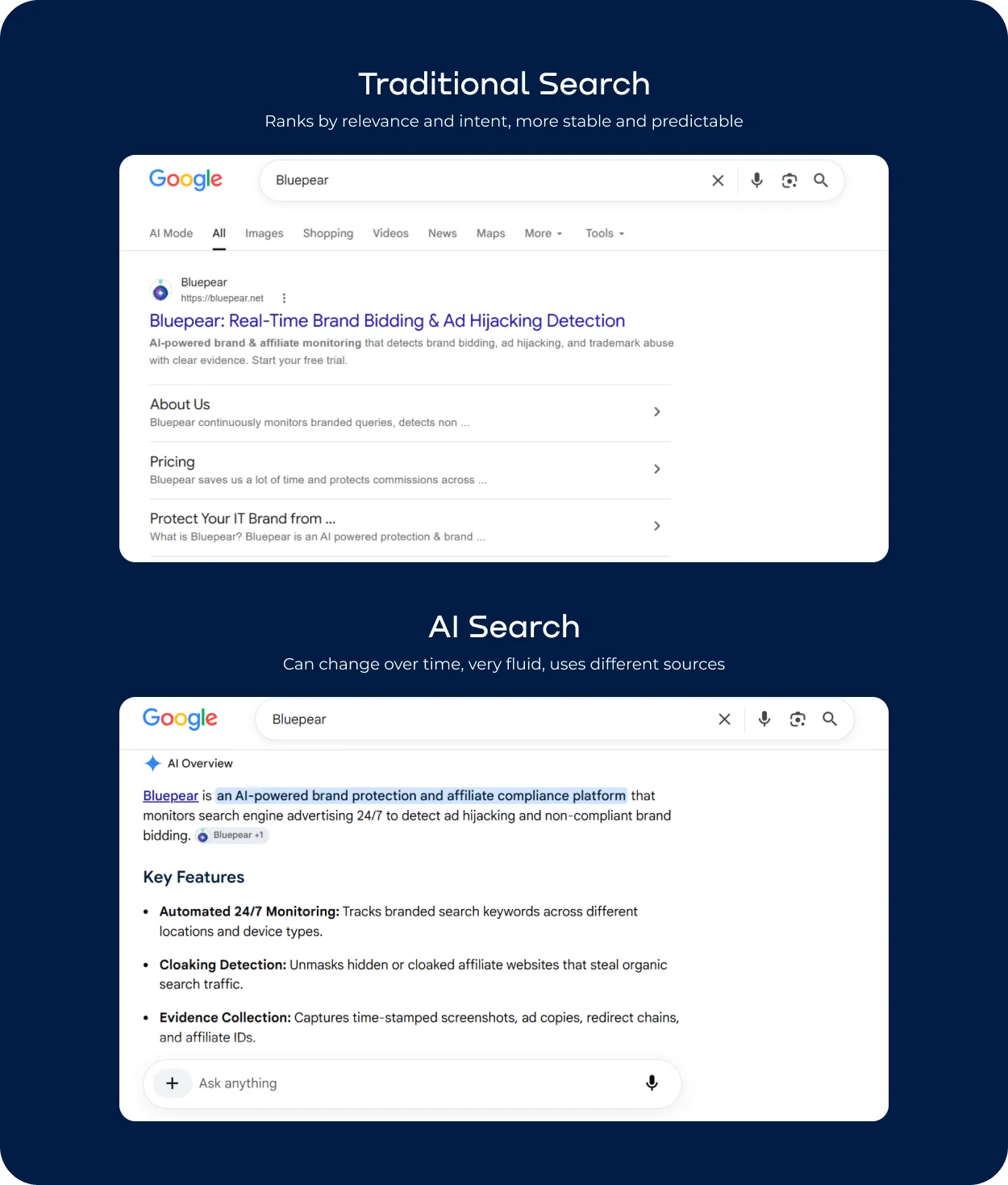
AI brand monitoring helps teams track what ChatGPT, Google AI Overviews, and similar platforms say about their brand and competitors.
For marketing and SEO teams, tracking relevant prompts helps identify gaps between traditional search visibility and LLM-generated answers.
PR and communications teams have another concern: what exactly the model says when asked about the brand or its products. An inaccurate product description, outdated information, or unfavorable comparison can potentially affect customer journey. Monitoring helps to spot these patterns and the sources behind them.
This layer is also relevant to brand protection and content teams. If AI repeatedly relies on a particular third-party material when describing the brand, the source may deserve further investigation.
**Most recommended AI search visibility tools are: **
-
• Otterly — appreciated as a relatively accessible way to keep track of brand visibility across AI search platforms, with regular reporting that makes changes easier to spot.
-
• Semrush AI Visibility Toolkit — users like having a simple visibility score and baseline for tracking how often a brand appears in AI answers over time.
-
• Profound — valued by larger teams for deeper AI visibility analysis, including long-term tracking and insight into which sources and citations shape how a brand appears in AI answers.
Conclusion: Online Brand Monitoring Today Is More Than Social Mentions
Brand monitoring was once a simple task revolving around tracking mentions and responding when something goes wrong.
Today, if you only monitor mentions, you miss:
-
• an affiliate bidding on brand and intercepting traffic;
-
• a competitor showing up above your ads;
-
• a coupon site giving away restricted discounts without authorization;
-
• a redirect chain hiding where the traffic actually goes;
-
• a misleading comparison in AI Overviews;
-
• a new advertiser capturing your branded demand.
The choice of appropriate brand monitoring tools should be based on what you actually need. You do not necessarily need a dozen services. Start with what can affect your revenue, reputation, or compliance, then choose tools that give your team actionable data for those visibility layers.
If branded search, affiliate compliance, or paid-search brand abuse are part of your monitoring needs, test Bluepear alongside your existing brand monitoring software stack. → Free trial available to all new users
FAQ
What is online brand monitoring?
Tracking how a company or brand appears and is discussed across relevant online platforms is called brand monitoring. Depending on the use case, it can revolve around reviews, search results, paid ads, affiliate activity, LLMs, or other layers.
AI brand monitoring — why does it stand out?
AI search is harder to monitor because there is no fixed SERP to check. Instead of showing the same ranked links for a query, LLMs generate answers that can vary with the prompt, model, location, context, and time.
That is why AI brand monitoring cannot be about tracking positions or a number of mentions. Instead, teams need to see how often the brand appears, how it is represented, which competitors are mentioned, and which sources are cited.
How to choose the right brand monitoring software?
Start with what you need to monitor. A PR team needs different coverage from a PPC team or an affiliate manager. Before choosing a tool, check whether it supports the way your team acts on findings — for example, reporting, compliance workflows, collaboration, or integrations with Slack.
Can one brand monitoring tool cover everything?
Usually, no. Most visibility layers rely on different data sources and tracking methods. Some services cover several layers, but specialized software is often needed when the goal is deep monitoring rather than broad visibility.

Try our PPC brand monitoring tool