
We’ll start by answering the question: what is competitor analysis software, and what is it used for?
The term competitor analysis tools refers to software and platforms that are built for monitoring and analyzing SEO performance, paid advertising activity, and website-level changes of competing brands.
In most industries today, competition is no longer an occasional challenge — it’s the default condition. Truly uncontested markets are increasingly uncommon, and in many verticals, multiple similar offers compete for the same users at the same time. If you’re not actively tracking competitor activity, it becomes difficult to stay aligned with market changes.
Leading companies continuously test new ad creatives, refine positioning, and launch updated features. Keeping up with this pace demands continuous competitor monitoring and a structured approach.
In this article we listed the best competitor analysis tools by category, their advantages, and best use cases. Read on for more information on:
-
• Semrush, Similarweb for cross-channel analysis
-
• Moz, Ahrefs, SE Ranking for SEO
-
• Bluepear, Adthena for PPC and compliance
-
• BuzzSumo, Hootsuite for SMM
-
• Klue, Crayon for competitor intelligence
Competitor Analysis vs Competitor Monitoring
Analysis is typically defined as one-time or periodic research that provides a snapshot of a specific market at a specific moment.
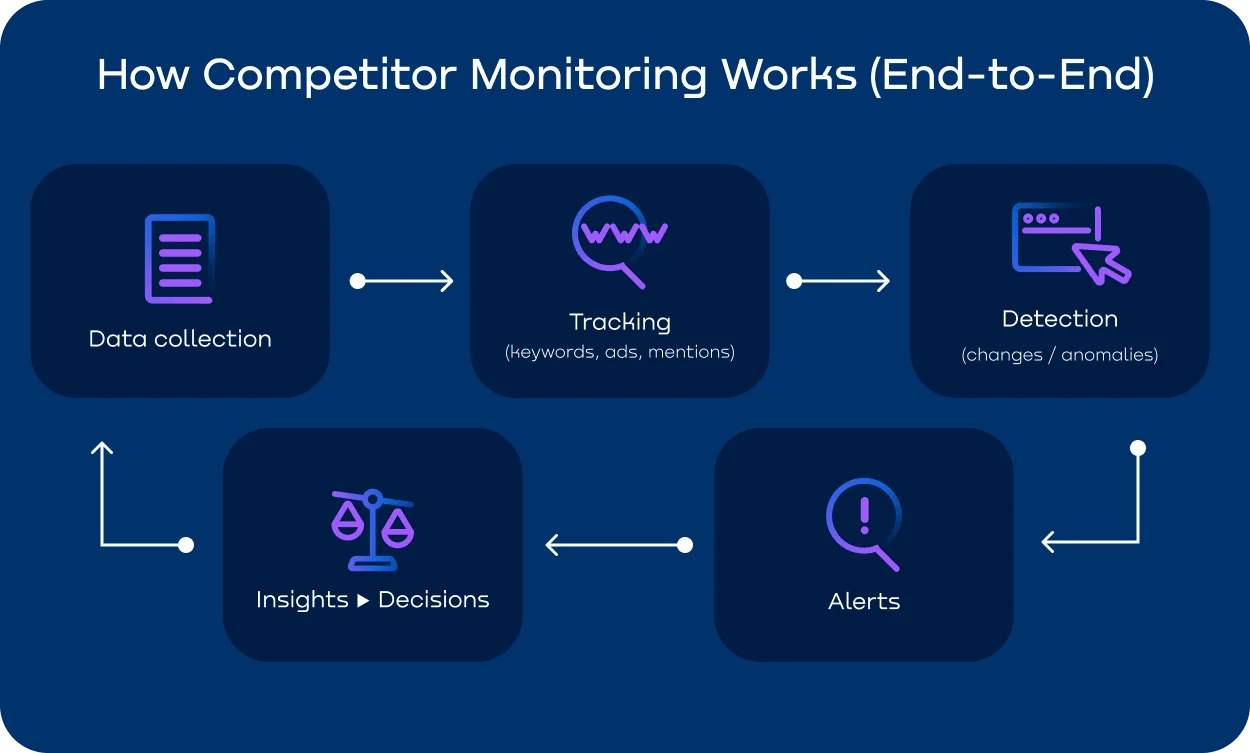
Competitor monitoring, on the other hand, is built around continuous tracking activity. Instead of isolated reports, you get ongoing visibility into what changes: new ads, ranking shifts, updated landing pages, pricing adjustments, or affiliate behavior. This makes the approach dynamic. You’re tracking what competitor activity as it happens, and reacting accordingly. In fast-moving channels or highly competitive markets, this is critical: you either monitor competitors continuously, or always lag behind.
What are the Best Competitor Monitoring Tools in 2026?
Not all competitor analysis tools solve the same problems. Some are centered around organic search, others on paid acquisition, brand protection, or broader competitor intelligence. In practice, an effective setup usually combines several tools — each covering a specific layer of visibility.
Table: Competitive Analysis Software by Application
The table below highlights widely used competitor research tools grouped by category, giving a quick overview of where each solution fits. The list is based on our team’s expertise and forum discussions:
| Application | Best Tools | Teams |
|---|---|---|
| All-in-One | Semrush, Similarweb | Growth teams, digital marketing teams, CMOs |
| SEO | Moz, Ahrefs, SE Ranking | SEO specialists, content teams |
| PPC & Advertising | Bluepear, Adthena | PPC managers, performance marketing teams, affiliate/compliance teams |
| Social & Content | BuzzSumo, Hootsuite | Social media managers, content marketers, PR teams |
| Competitor Intelligence | Klue, Crayon | Product marketing, strategy teams, sales enablement |
All-in-One Competitor Analysis Tools
Semrush
An established online platform that is often recommended as a central competitor analysis tool for SEO and PPC and use for competitor tracking.
Strengths:
-
• Broad datasets for SEO analysis
-
• Integrated PPC data
-
• Cross-channel benchmarking
-
• Large global keyword database
Limitations:
-
• Monitoring is not real-time
-
• A wide set of features can make workflows too complex for new users
-
• Accuracy depends on keyword volume, geo, and dataset density
Best use cases:
-
• Researching competition across search
-
• Building ongoing SEO visibility monitoring
-
• Finding keyword for content strategy
Similarweb
An online platform that primarily focuses on market-level visibility and traffic patterns.
Strengths:
-
• Traffic estimates across different channels
-
• Data on traffic sources and user behavior
-
• Can help in detecting new competitors through traffic trends
Limitations:
-
• Lower accuracy for smaller or low-traffic sites
-
• Less granular keyword-level SEO data compared to specialized tools
Best use cases:
-
• Understanding relative traffic distribution between competitors
-
• Evaluating market share and visibility
-
• Benchmarking in a niche
SEO Competitor Analysis Tools
Ahrefs
Primarily an SEO-focused platform popular among SEO specialists due to its large backlink index and strong website exploration capabilities.
Strengths:
-
• One of the largest commercial backlink indexes
-
• Reliable keyword difficulty metrics and ranking data
-
• Clean interface focused on SEO workflows
-
• Strong historical data tracking
Limitations:
-
• Limited search ad monitoring features
-
• Limited coverage of less popular search engines such as Yandex or Baidu
Best use cases:
-
• Developing strategy for outreach and link building
-
• SEO audits
-
• Complex analysis of competition in organic search
-
• Tracking competitor organic growth over time
Moz
An established entry-level competitor research tool often used for analysis and domain-level benchmarking in SEO.
Strengths:
-
• Straightforward workflows suitable for beginners in SEO
-
• Metrics for quick benchmarking such as DA/PA
-
• Solid foundation for basic SEO insights
Limitations:
-
• Smaller link and keyword indexes in comparison to larger platforms
-
• DA/PA are proprietary metrics and should be used as relative indicators, not absolute authority values
-
• Limited capabilities for cross-channel competitor monitoring
Best use cases:
-
• Basic visibility monitoring and technical SEO audits
-
• Learning-oriented SEO analysis workflows
-
• Tracking competitor organic positions in search engines
SE Ranking
A flexible SEO research platform combining several basic features for comparing competitors.
Strengths:
-
• Reliable organic rank tracking
-
• Competitive pricing compared to enterprise-level SEO platforms
-
• Customizable reporting
Limitations:
-
• Smaller databases compared to larger platforms
-
• Coverage depth varies depending on region and niche
-
• Limited third-party integrations in comparison to larger ecosystems
Best use cases:
-
• Tracking rankings in organic search over time
-
• Comparing website performance against direct competitors
PPC Competitor Analysis Tools
Bluepear
A self-service online platform built for tracking brand bidding and affiliate compliance that also allows tracking competitors in PPC.
Strengths:
-
• Detection of brand bidding activity through SERP observation and keyword tracking
-
• Evidence-based reporting with captured timestamped ad snapshots
-
• Transparent dashboards with evidence-based reports
-
• Direct alerts to email, Slack, or Telegram
Limitations:
-
• Coverage depends on completeness of keyword lists
-
• Monitoring is based on search result observation rather than direct access to advertising platforms
-
• Strongest focus is on PPC and affiliate environments rather than full SEO intelligence
Best use cases:
-
• Monitoring competitors bidding on branded keywords
-
• Detecting affiliate violations and unauthorized traffic sources
-
• Supporting internal compliance and PPC governance workflows
-
• Tracking SERP-level changes in brand-related auctions
Right now a free trial period is available to every new Bluepear user after a quick signup — try it if you want to test how the tool compliments the workflow of your PPC or affiliate marketing team.
Adthena
An online platform built around search intelligence and forming a deep understanding of competitive behavior in PPC environments.
Strengths:
-
• Aggregated data on competitor bidding patterns
-
• Analysis of auction participation patterns
-
• Market share insights within paid search landscapes
-
• Clear information on competitor overlap and positioning dynamics
Limitations:
-
• Focused primarily on paid search; limited functionality outside PPC environments
-
• Data requires interpretation, as it is based on modeled search observations
-
• Enterprise-oriented tool that requires structured workflows for effective use
Best use cases:
-
• Mapping competitive dynamics in PPC auctions
-
• Flagging notable changes in competitors’ bidding behavior
-
• Discovering new or previously unnoticed competition in PPC
Social & Content Monitoring Tools
BuzzSumo
A platform focused on analyzing content performance.
Strengths:
-
• Identification of content that performs well with segmentation by topic or competitor
-
• Discovery of trending content formats and themes
-
• Capabilities for content gap analysis
Limitations:
-
• Not a full competitor monitoring solution
-
• Data coverage is dependent on API access limitations of social networks
-
• Focused primarily on content performance signals rather than full digital visibility
Best use cases:
Tracking popular formats and topics that bring higher engagement Planning SMM or blog strategy and refining content plans Understanding what content target audiences engage with
Hootsuite
Primarily an SMM platform that also allows basic competitor monitoring.
Strengths:
-
• Unified dashboard for scheduling content and posting it on social media
-
• Benchmarking of user engagement
-
• Tracking competing content in social channels
Limitations:
-
• Limited analytical depth
-
• High-level competitor insights
Best use cases:
-
• Managing multi-channel social publishing
-
• Monitoring competitor presence on social media platforms
-
• Tracking brand mentions in social channels
Competitor Intelligence Platforms
Klue
A competitor intelligence platform designed to support sales enablement and strategic decision-making.
Strengths:
-
• Centralized repository for competitor intelligence data
-
• Workflow tools for organizing insights across teams
-
• AI-assisted summarization and categorization of incoming competitive signals
-
• Integration with internal knowledge bases
Limitations:
-
• Depends heavily on external data sources and manual input
-
• Not a real-time tracking system for market changes
-
• AI features focus on structuring information rather than autonomous analysis
-
• Requires team adoption to deliver value
Best use cases:
-
• Centralizing scattered competitive data from multiple sources
-
• Building internal competitor intelligence systems
-
• Supporting sales teams with competitive insights
-
• Tracking changes in positioning and messaging
Crayon
A platform designed for tracking competitor activity across digital channels.
Strengths:
-
• Automated monitoring of website, content, and messaging updates
-
• Detection of changes across multiple touchpoints
-
• Strong workflows for ongoing competitor monitoring
Limitations:
-
• Limited depth in SEO and PPC analytics
-
• Better suited for monitoring than deep analytical modeling
-
• Higher complexity for beginners or smaller teams
Best use cases:
-
• Monitoring product announcements and notable changes on a website
-
• Detecting strategic shifts in communication
-
• Monitoring competitors’ messaging
How to Choose the Right Competitor Analysis Tools
When choosing competitor research tools keep in mind that the best tools are not defined by features alone, but by how they fit into your team’s workflow.

We recommend approaching the selection of competitor research tools with these three factors in mind:
- 1. Your goals: Different platforms are built for different types of competitor monitoring. In most cases, a single tool won’t cover all the areas. The goal is to align tools with the channels that your brand uses for promotion and customer acquisition — PPC, SEO, affiliate marketing, etc.
- 2. Team type: Different teams apply competitor data in different ways. Choosing tools without considering this often leads to underused features or unnecessary complexity.
- 3. Budget: Budget plays a practical role, but remember — software should be considered in terms of coverage, not just cost.
4 Best Practices in Competitor Monitoring
Having competitor analysis tools at your disposal is only part of the equation. In this section of the guide we share a short list of best practices to consider. It is based on practical workflows and user insights from teams actively tracking competitor activity that we collected from internet discussions and personal experience.
1. Track Continuously, Not Occasionally
One of the common mistakes is treating competitor research as a periodic task. Most companies test new ad campaigns, adjust bids, launch new landing pages, and refine positioning constantly. If you don’t monitor competitors, flagging changes as they happen, you’re reacting late. Continuous competitor monitoring shifts the focus from reporting to action. Rather than asking “what changed last month?”, you start asking “what is changing now and what should we do about it?”
2. Combine Multiple Data Sources
There is no single tool that provides a complete view. Relying on just one source creates blind spots. Effective setups combine different types of competitor research tools. This multi-source approach transforms isolated data into high-value competitor intelligence usable for strategic growth.
3. Validate Data Manually
Even the best competitor monitoring tools rely on estimates and automated detection. Acquisition can be delayed, the data itself — incomplete or misinterpreted if taken at face value. That’s why manual validation remains important — especially for high-impact decisions. This step ensures that competitor insights are not just fast, but accurate. Automation provides scale, but human review adds context.
4. Focus on Signals That Indicate Change
A key insight from teams actively monitoring their competition: the goal is not to simply track everything, but to single out the signals that indicate meaningful shifts.
These signals may reveal what competitors invest in and how they evolve their strategy:
-
• Consistent movement in rankings for high-value keywords
-
• New landing pages and use cases
-
• Hiring patterns that hint at strategic direction
-
• Sudden changes in ad messaging or offers
Test PPC monitoring tool Bluepear for free
Final Thoughts on Competitor Analysis Tools
Competitor analysis tools today have moved far beyond research to shaping strategy and protecting brand and its performance.
The shift towards continuously tracking competitor activity is visible in PPC environments, in SEO, affiliate marketing, and even product strategy. The real value of competitor insights depends on how quickly they are captured and acted upon.
Modern monitoring tools function as a part of a wider system that helps teams monitor competitors consistently, filter meaningful changes, and respond with context. This is what turns competitive analysis software from a reporting utility into a real driver of growth.
FAQ
What should you track in competitor monitoring?
Effective competitor monitoring focuses on signals that indicate change, not just static data. This includes keyword rankings, ad copy updates, brand bidding activity, new landing pages, notable pricing changes, and even affiliate activity. The goal is to flag meaningful shifts in both strategy and performance, not just collect metrics.
Can competitor analysis tools identify brand bidding?
Not all tools offer this capability. Specialized monitoring tools — particularly in PPC and brand protection — are designed to detect when someone bids on your branded keywords. These tools typically rely on SERP tracking and provide evidence-based reporting.
How do competitor research tools collect data?
Most competitive analysis software gathers data from multiple sources, including search engine results pages (SERPs), third-party clickstream data, and publicly available website information. Some tools also use machine learning to model traffic and estimate competitor performance. Because of this, combining multiple data sources often leads to more reliable competitor insights.
Do competitor analysis tools have any important limitations?
While powerful, competitor research tools are not perfect. Common limitations include delayed data updates, incomplete coverage, and reliance on estimates rather than exact figures. That’s why competitor monitoring brings the most value when automated insights are combined with manual validation.
Competitor analysis and competitor intelligence: is there a difference?
The difference comes down to how the data is applied in practice.
Competitor analysis is typically a one-time or periodic review of competitor websites, keywords, ads, or positioning. It’s often static and retrospective — a snapshot of the market at a particular moment.
Competitor intelligence, on the other hand, is continuous. It’s built around ongoing data collection. In more mature teams, competitor intelligence becomes part of daily operations.

Check if Your Competitors Bid on Your Brand