
The guide focuses on google ads trademark policy within PPC practice, not on every support pathway or appeal type. A separate overview covers broader complaints and procedures: google ads trademark complaint and google trademark infringement, so this guide stays focused on google ads trademark policy. Under Google’s trademark rules, ad text and landing pages must match user intent and avoid confusion.
Planning around google trademark keywords secures branded intent while limiting spend leakage common in affiliate programs and competitive bidding. Teams managing trademark use in Google Ads benefit from clear partner rules, transparent disclosures, and evidence capture across GEOs and devices. Updates in google ads trademark policy arrive periodically, yet core principles remain stable.
Guidance inside google trademark policy emphasizes truthful presentation and relevance. Building a coverage plan for google trademark keywords reduces disputes and accelerates reviews. Keeping procedures aligned with google ads trademark policy sets expectations for partners and internal stakeholders.
| Question | Answer |
|---|---|
| Can competitors bid on branded queries? | Yes |
| Can competitors use a mark in ad text? | No |
| Does the policy differ in the EU? | Yes |
| Does the platform track who has permission? | No |
| Can violations reappear later? | Yes |

Q&A — practical scenarios
Who may bid on your branded keywords in Google Ads?
Under google trademark policy, bidding on google trademark keywords by competitors or resellers can be allowed if the landing page is relevant and non-misleading. Many brands run defensive campaigns while partners obtain written bidding.
Effective governance treats trademark google ads as intent capture, not automatic exclusivity. Document permissions for affiliates and keep a whitelist.
Who may use a trademark in ad copy?
Resellers, informational sites, and compatible services can reference a protected term in text if the use reflects truthful availability and does not imply official endorsement. Guidance inside google ads trademark policy describes boundaries for ad text; broader principles in google trademark policy reinforce the need for clarity on the page. For reliability, align copy with the offer, then verify how it displays across devices and GEOs. Clear labels help when running trademark google ads for comparisons.
Does the policy differ in the EU?
Yes. Regional law makes transparency essential. In the EU, rules are stricter, and Google accounts for them by enforcing additional safeguards. Teams should review evidence that supports relevance for google trademark keywords and avoid headlines suggesting an “official site” without authorization. The same baseline in google ads trademark policy applies, but execution varies. Treat trademark google ads in the EU as a compliance-first exercise.
Can the platform tell who you authorized?
No automated cross-account registry exists. Reviewers rely on the information supplied by rights holders. Internal records matter: partner names, dates, and territories. When submitting a limited authorization, reference the exact phrases and campaigns governed by google trademark policy, plus the list of google trademark keywords covered. Clear scoping reduces unintended blocks affecting legitimate partners. Map the exact google trademark keywords and negative variants to avoid bleed.
Why do competitors target my brand terms?
Because branded intent converts. In e-commerce, rivals often target your shoe or cosmetics brand via branded keywords on Google to promote price-match or bundle offers. In SaaS, a CRM competitor may bid on your brand term to advertise a migration or onboarding discount, provided ad copy stays truthful and the landing page explains the offer. Strong first-position coverage plus monitoring under google ads trademark policy typically lowers waste. In travel, OTAs run on hotel brand queries to compare rates; the tactic aligns with policy when the page actually sells the rooms and disclosures remain clear.
Why does a competitor show my mark in ad text?
Two common reasons: genuine resell or aggressive comparison. Use moderation rules in google ads trademark policy to challenge misleading phrasing. Cross-check copy against inventory and refund policies on the landing page. Broader language under google trademark policy supports action when the ad suggests affiliation that does not exist. Persistent misuse often appears at night hours or in secondary GEOs.
Live Trademark Abuse Radar
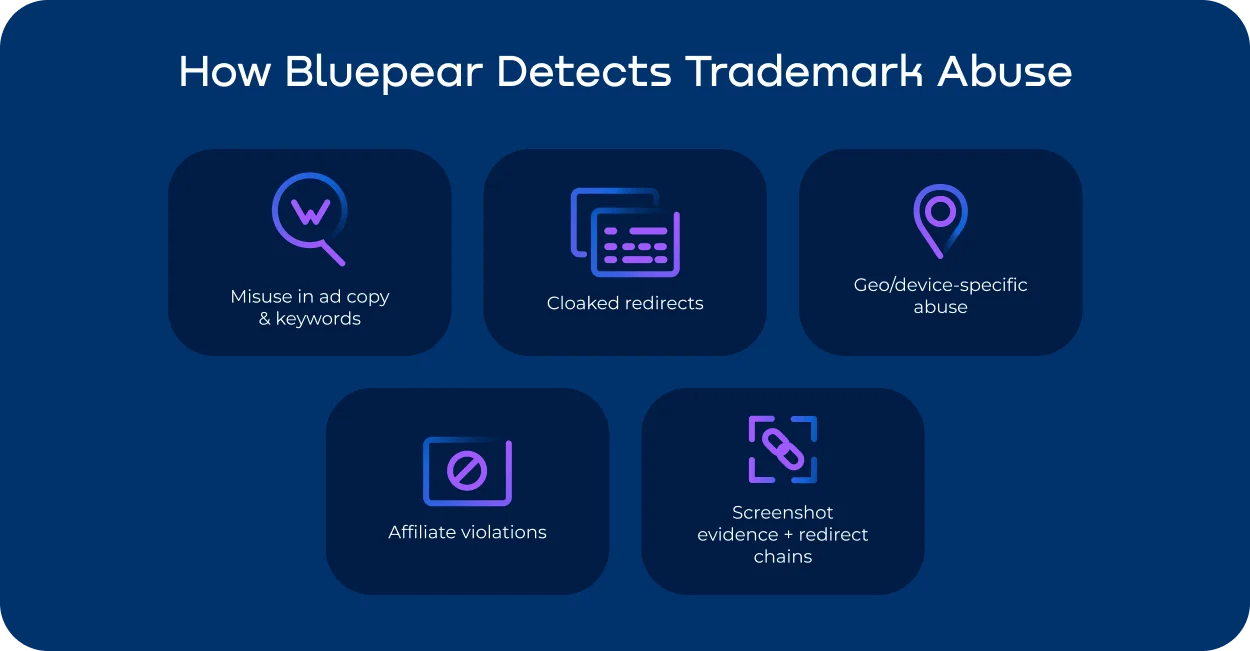
Bluepear detects:
-
• Trademark misuse in Google Ads (ad copy + keywords)
-
• Cloaked redirects and masked landing pages
-
• Brand bidding and affiliate violations
-
• Violations targeting specific GEOs, devices, or dayparts
-
• Screenshot evidence + redirect chains + affiliate IDs
Built for PPC teams, Bluepear mirrors real users across locations and schedules, surfaces risky creatives and queries, and packages proof for reviewers and partners. Setup takes minutes and early findings typically appear within an hour, helping protect branded intent where it matters most.

What are the most common violations?
Typical patterns include cloaked redirects, “official site” claims without authorization, bait-and-switch pages, and undeclared affiliates. Watch for broad matches that drag a protected term onto irrelevant pages. Both google ads trademark policy and google trademark policy treat deception as the core risk. Under google trademark policy, misleading identity statements trigger restrictions. Logging evidence shortens review time for trademark infringement google ads cases.
What happens after a complaint reaches Google?
Review focuses on mark ownership, ad examples, and user confusion risk. If a violation is found, Google may restrict the trademark's use in ad text or apply ongoing limitations to affected ads, prioritizing compliance over a full pause.
Rights holders often keep a list of permitted partners to prevent over-blocking. Process scope here remains within trademark rules; other complaint types live in the separate overview linked above, including the dedicated page on google ads trademark complaint. Enforcement follows google trademark policy principles. Keep a changelog tied to google trademark keywords so recurring actors can be tracked and actioned quickly.
Do violations return after removal?
Yes, especially with new accounts, time-based tests, and GEO hopping. Continuous monitoring aligned to google ads trademark policy helps prevent repeat issues. Evidence archives screenshots, redirect maps, affiliate IDs enable faster action under google trademark policy. Teams that treat trademark google ads as an always-on risk surface reduce wasted spend and protect brand equity. Treat trademark google ads as an evergreen risk area.
Conclusion
Consistent outcomes arrive when teams observe real SERPs, capture proof, and act quickly under google ads trademark policy and google trademark policy. Bluepear renders live results like a user, packages screenshots, redirect chains, and affiliate IDs for reviewers, and supports partner discussions. Setup takes minutes; early findings often appear within an hour. Treat trademark google ads as an always-on surface for brand safety, and keep policy-aligned monitoring in place.

Protect Your Brand Now!