
According to WordStream's latest benchmark data, average CPC increased for 87% of industries in 2025, with some sectors seeing jumps of more than 40% year over year. The overall average CPC rose by 12.9%, continuing a multi-year trend of rising search advertising costs. Industries such as Beauty & Personal Care, Education, and Shopping experienced some of the sharpest increases.
That rise of advertising costs creates challenges both for new advertisers launching their first campaign and experienced PPC teams that need to maintain profitability. Realizing that, we wrote this guide on PPC bidding in digital marketing, the common strategies and best practices.
How Does PPC Bidding Work?
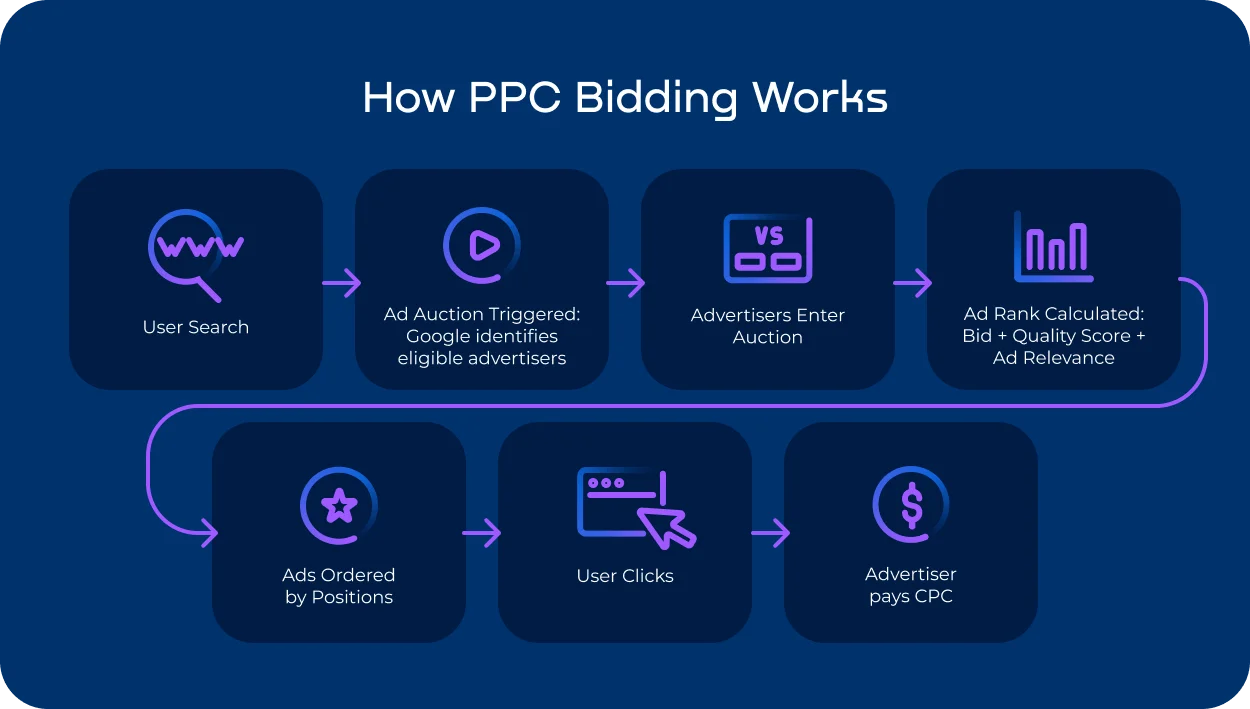
To explain the concept and mechanics of PPC bidding, we’ll use Bluepear as an example. We'll also use Google Ads for this explanation, as Google remains the dominant search engine worldwide, accounting for approximately 90% of global search engine market share in 2026. (StatCounter)
Imagine a user searches for "PPC brand bidding software". The moment they hit Enter, an auction starts. It is invisible to the user, but it decides whether they see Bluepear’s ad in search results.
First, the platform identifies advertisers targeting that keyword or a close variation. Several companies offering brand protection, affiliate monitoring, or PPC software may become eligible to participate.
Next, the search engine calculates an Ad Rank. According to the information provided in Google Ads Help, that calculation considers several factors:
-
• Ad relevance
-
• Ad quality at auction time
-
• Competitiveness of an auction
-
• Maximum bid amount
-
• Search context
-
• Expected impact of assets and ad formats
-
• Landing page experience
After the auction is complete, the ads are ordered, and the winners appear in search results.
In the end, the highest bid doesn't always win. Let’s look at a simplified example:
| Advertiser | Bid | Quality Score | Outcome |
|---|---|---|---|
| Competitor A | $5 | 4 | Position 2 |
| Bluepear | $3 | 9 | Position 1 |
| Competitor B | $6 | 3 | Position 3 |
Here Bluepear wins the first position, despite bidding less. It is because Bluepear's ad closely matches the search query and receives higher Ad Rank while competitor ads are less relevant.
This is one of the important concepts in pay-per-click bidding in digital marketing: increasing bids can help, but improving quality often produces better results at a lower cost.
Common PPC Bidding Strategies and When to Use Them
Imagine we're managing PPC ads for Bluepear. We have several goals at once. We want visibility for searches like "Bluepear." We want leads from searches such as "affiliate monitoring software". And we want to get them without overspending our marketing budget.
Manual CPC Bidding
If we were launching a new Bluepear ad campaign, Manual CPC would probably be our starting point.
At this stage, we don't yet know which keywords will generate demos, which searches are purely informational, or how much traffic is available. We want to see the data before handing decisions to an algorithm.
When this strategy makes sense:
-
• New campaigns with little conversion history
-
• Testing new keyword groups
-
• High-value keywords that require close management
Pros:
-
• Best manual control over spending
-
• Easier to identify winning and losing keywords
-
• No reliance on historical data
Cons:
-
• Requires careful manual management
-
• Difficult to scale
-
• Slower to react to auction changes
Enhanced CPC
After gathering some conversion data, we might move to eCPC.
This PPC bidding strategy works like that: if two searches look similar on the surface, but one consistently produces leads, Google can increase bids for that auction while lowering them for less promising traffic.
When this strategy makes sense:
-
• Accounts transitioning from manual pay-per-click bidding
-
• Teams that want automation clear with visibility into bid decisions
Pros:
-
• Uses conversion signals during auctions
-
• Requires less manual management
Cons:
-
• Less predictable than Manual CPC
-
• Limited control over bids
-
• Dependent on conversion tracking quality
Maximize Clicks
Suppose we're launching a new content campaign around topics like "PPC brand bidding".
At this stage, the goal is traffic rather than immediate conversions. Maximize Clicks is designed for exactly that scenario.
When this strategy makes sense:
-
• Traffic acquisition
-
• Content promotion
-
• Building remarketing audiences
Pros:
-
• Maximizes traffic volume
-
• Useful even when conversion data is limited
Cons:
-
• Optimizes for clicks, not lead quality
-
• Can attract low-intent traffic
-
• Budget can be spent inefficiently
Maximize Conversions
Now imagine a campaign has been running for several months. We know which keywords generate leads and which ones rarely convert. Instead of maximizing traffic, we want to maximize leads. That's where Maximize Conversions becomes attractive.
When this strategy makes sense:
-
• Lead generation focused on acquisition volume
-
• Accounts with reliable conversion tracking
Pros:
-
• Optimizes toward conversion goals
-
• Reduces manual bid management
-
• Adapts to auction signals automatically
Cons:
-
• Requires conversion history
-
• Less transparency into bid decisions
-
• May spend budget aggressively
Target CPA
As the account matures, lead volume alone is no longer enough.
Suppose we are willing to pay up to a specific amount for a qualified demo request. Rather than chasing as many leads as possible, the new goal is to maintain control over acquisition costs.
That's the role of Target CPA.
When this strategy makes sense:
-
• Mature lead generation campaigns with stable conversion data
-
• Brands with clear CPA targets
Pros:
-
• Focuses on acquisition efficiency
-
• Automates bid management
-
• Helps maintain predictable costs
Cons:
-
• Requires substantial conversion volume
-
• Unrealistic targets can restrict traffic
-
• Performance may fluctuate during learning periods
Target ROAS
Not every conversion has the same value. If we were running an ecommerce business, some purchases would be worth far more than others. In that scenario, revenue matters more than conversion count.
The best pick here is Target ROAS as it tweaks bids based on expected return.
When this strategy makes sense:
-
• Ecommerce campaigns
-
• Accounts built around profitability
Pros:
-
• Optimizes for revenue
-
• Prioritizes higher-value opportunities
-
• Aligns pay-per-click bidding with business outcomes
Cons:
-
• Needs significant historical data and accurate revenue tracking
-
• Can limit volume in some cases
Maximize Conversion Value
With this strategy, the platform looks for the highest-value conversions available within the given budget. For example, if some Bluepear keywords consistently generate enterprise leads while others attract smaller accounts, the system may prioritize auctions that produce higher-value opportunities.
When this strategy makes sense:
-
• Accounts tracking conversion value
-
• Growth-focused campaigns
-
• Revenue-driven optimization
Pros:
-
• Fully automated
-
• Identifies high-value opportunities
Cons:
-
• Needs accurate value tracking
-
• Gives less control over pay-per-click bidding decisions
-
• Can prioritize value at the expense of volume
How to Choose the Right PPC Bidding Strategy
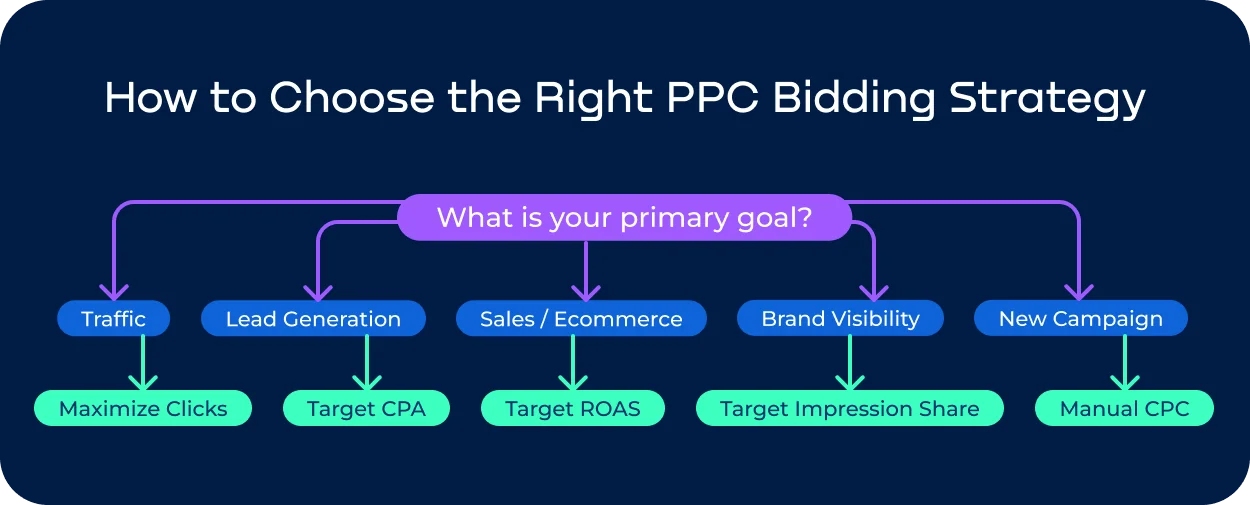
At this point, we've built keyword lists, launched ads, and started collecting data. The next question is which PPC bidding strategy fits each stage of the account. The answer depends on what we're trying to achieve.
| Strategy | Control Level | Data Required | Best For |
|---|---|---|---|
| Manual CPC | High | Low | New campaigns |
| Max Clicks | Low | Low | Traffic |
| Max Conversions | Medium | Medium | Lead generation |
| Target CPA | Low | High | Mature accounts |
| Target ROAS | Low | High | Ecommerce |
The best PPC bidding strategies are often temporary. As an account evolves, the bidding approach should evolve with it.
For example, if we're launching Bluepear into a new market and targeting keywords such as "brand protection software" or "affiliate monitoring platform," we have very little conversion data. In this situation, we'd start with Manual
CPC. It allows us to learn which keywords generate demos before automation starts making decisions on our behalf.
After several months of campaign activity, the account looks very different.
We know which searches generate qualified opportunities, which audiences perform best, and which keywords consistently underperform. This is where automated pay-per-click bidding strategies become most valuable because they can use historical signals that are difficult to keep track of manually.
PPC Bidding for Brand Campaigns
PPC brand bidding is often treated as a defensive PPC bidding strategy designed to protect visibility and high-value traffic from competitors.
Imagine someone searches for "Bluepear." We can choose to run ads on that keyword, to make sure that users who are actively looking for Bluepear reach Bluepear. We can highlight a specific feature or direct them to the most relevant landing page.
That creates several advantages:
-
• Greater control over the SERP
-
• Protection against PPC competitor brand bidding
-
• Typically higher conversion rates
-
• Usually lower CPCs than non-brand keywords
In our experience, branded traffic often behaves differently from generic searches. Someone searching for "affiliate monitoring software" is still researching options. Someone searching for "Bluepear" has already narrowed the field considerably.
As branded ads are made with different goals than non-branded ones, they need separate management:
- • Separate branded keywords from generic ones to control budgets, bids, and performance metrics independently.
- • Prioritize impression share over traffic volume — the goal is SERP ownership rather than maximizing conversions.
- • Use exact and phrase match for core brand keywords.
- • Monitor CPCs separately — brand traffic often has lower CPCs and higher conversion rates than generic keywords, so performance benchmarks should be different.
- • Watch for sudden CPC increases, as rising costs can indicate new competitors entering the auction or affiliates bidding on your trademarked keywords.
- • Use Manual CPC to maintain control over costs or Target Impression Share for automated pay-per-click bidding.
Monitoring PPC Competitor Brand Bidding
When investing in PPC brand bidding, visibility into branded PPC often becomes as important to controlling the budget as the bids themselves.
If competitors or affiliates begin brand bidding, competition in those auctions increases. That can force you to bid more aggressively to maintain the same level of visibility, leading to higher CPCs.
Without monitoring, it's difficult to understand why branded traffic suddenly becomes more expensive. You may increase bids simply to hold your position, without realizing that a new competitor or affiliate has entered the auction.
Bluepear is a platform built for monitoring brand bidding, affiliate marketing compliance, and competitor activity in PPC. With automated scanning, you can monitor ads across different countries, cities, devices, languages, and time zones.
Try Bluepear for free to see when competition appears, understand where it's happening, and make informed bidding decisions based on real auction activity rather than guesswork.

PPC Bidding Best Practices
The recommendations below consistently appear in conversations we have with PPC specialists that we work with. They're also common themes in discussions among experienced PPC practitioners on Reddit and professional marketing forums.
-
1. Use and update negative keywords: Negative keywords prevent budget from leaking into searches that are unlikely to convert.
-
2. Monitor Auction Insights: Auction Insights often reveals changes before they appear in performance reports. For example, in case of PPC competitor brand bidding, impression share trends will often reveal the signs of it.
-
3. Review your search terms regularly: Some of the best keyword opportunities we've found came from queries we never planned to target. The same reports also reveal irrelevant searches that should be excluded.
-
4. Adjust bids by device, location, and time: A search from New York during business hours may perform differently from a mobile search late at night. Look for patterns and tweak bids accordingly.
Common PPC Bidding Mistakes
Below are the things we recommend not doing:
- • Raising bids rather than working on Quality Score: A more relevant ad, tighter keyword grouping, or a better landing page can often improve visibility without increasing costs.
- • Choosing Smart Bidding without sufficient conversion data: Automation needs signals. Launching Target CPA or Target ROAS campaigns before enough conversions have accumulated often creates unstable results because the system has very little data to learn from.
- • Ignoring brand campaigns: Many advertisers spend months optimizing non-brand acquisition while giving little attention to branded searches. Meanwhile, competitors or affiliates may be appearing on their most valuable keywords.
- • Not monitoring competitor activity: Search auctions change constantly. New competitors enter markets. Existing competitors become more aggressive. Affiliate activity appears unexpectedly. If you're not monitoring branded search results, these changes can continue for weeks before they become visible in performance reports.
- • Treating all keywords the same: A branded search, a competitor comparison search, and a generic informational query often behave completely differently. Setting the same bids, goals, and expectations across all keyword groups rarely produces the best results.
Conclusion
The goal of PPC bidding strategies isn't to win every auction. It's to win the right auctions at a cost that makes sense for your business.
That usually means spending less time chasing higher bids and more time improving the factors you can actually control: campaign structure, ad relevance, landing pages, keyword segmentation, and the bidding strategy itself.
Frequently Asked Questions
Is pay-per-click bidding only about setting the highest bid?
No. In modern pay-per-click bidding, the maximum bid is only one part of the auction. Platforms also evaluate factors such as ad relevance, landing page experience, and other quality signals. Improving those elements often produces better results than simply increasing bids.
Should I run PPC brand bidding campaigns?
In many cases, yes. PPC brand bidding helps protect high-intent searches from competitors and increases your visibility on the search results page.
Is PPC competitor brand bidding allowed?
In most advertising platforms, brand bidding is permitted. What is usually restricted is the use of trademarks in ad copy. The exact rules depend on the advertising platform and local trademark laws.
Why do my branded clicks become more expensive over time?
One common reason is increased competition in branded auctions. New competitors, resellers, or affiliates may begin bidding on your trademarked keywords, forcing you to compete more aggressively for the same traffic. Monitoring branded search results helps identify these changes before they significantly affect your advertising costs. A PPC brand monitoring tool can continuously track branded search results, helping you identify unauthorized affiliate activity, competitor ads, and changes in branded auction competition across different markets.
What is the role of bidding in digital marketing beyond Google Ads?
The principles of bidding in digital marketing are similar across most major advertising platforms. Whether you're advertising on Google or Microsoft Advertising, auctions use a combination of bid amount and quality signals to determine which ads are shown.

Check if Your Competitors Bid on Your Brand