
Contents
Google Ads reports that advertisers who increase their account Optimization Score by just 10 points achieve a median 14% increase in conversions. While every account is different, the data highlights that consistent optimization of PPC campaigns has a measurable impact on marketing performance.
As competitors change bids, search behavior evolves, CPCs fluctuate, and yesterday's winning ads slowly lose efficiency, it's easy to start spending more while getting less qualified leads and fewer sales.
This guide explains what is PPC optimization, which metrics deserve your attention, and which techniques can actually make your campaigns perform at benchmark levels — or above them.
How Often Should PPC Campaigns Be Optimized
The ideal schedule may vary for different accounts. Competitive businesses often benefit from daily monitoring because conditions can change very frequently. Smaller accounts with limited traffic may need less frequent changes, as making decisions before enough data is collected can do more harm than good.
The key is consistency rather than constant intervention. PPC campaign optimization is effective when based on reliable data, not reacting to every short-term fluctuation.
As a general rule, experienced PPC managers follow a cadence like this:
- • Daily: Monitor spend, conversion tracking, disapproved ads, and any sudden changes in performance.
- • Weekly: Review and update keyword lists based on performance, adjust bids, evaluate audience segments, and run tests to find valuable opportunities and improve PPC ads.
- • Monthly: Perform a broader PPC audit by reviewing campaign structure, bidding strategy, Quality Score trends, landing page alignment, and overall ROI against your business goals.
- • Quarterly: Revisit and reassess your objectives and overall PPC strategy and identify new growth opportunities.
PPC Optimization Process: A Step-by-Step Framework
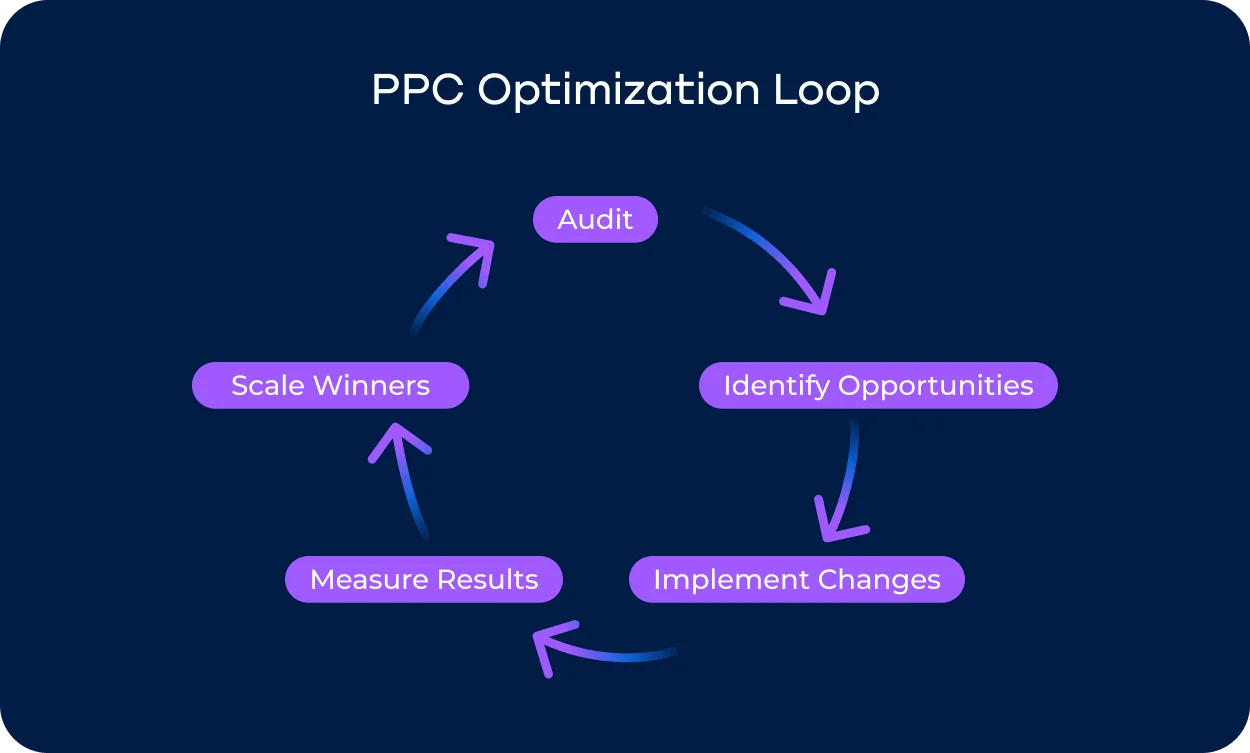
Rather than answering the question “What is PPC optimization?” with a quote from a dictionary, we’ll describe the overall process.
The framework below shows the sequence experienced PPC managers typically follow when optimizing campaigns:
-
1. Audit your current performance: Start with a simple audit to understand where your account stands today. Review campaign structure, conversion tracking, search terms, Quality Score, and budget allocation. The goal is to identify wasted spend and uncover the biggest opportunities for improvement.
-
2. Define optimization goals: Decide what success looks like before making changes. Your priority may be generating more qualified leads, increasing ecommerce revenue, improving ROAS, lowering CPA, or strengthening brand visibility. Clear goals help you avoid optimizing for the wrong metrics.
-
3. Prioritize opportunities: Start with quick wins, such as fixing tracking issues or adding negative keywords, then move to larger improvements like restructuring campaigns or testing new bidding strategies.
-
4. Apply PPC optimization techniques: Make changes based on performance data. Do it systematically rather than all at once.
-
5. Measure the results: Allow enough time for campaigns to collect meaningful data before drawing conclusions. Compare results against your original objectives and focus on business metrics such as conversions, ROAS, CPA, and revenue rather than clicks alone.
-
6. Monitor competitors and repeat the cycle: Continue monitoring competitor activity and market trends alongside your own performance. Each round of analysis creates new opportunities to refine your PPC strategy and improve results over time.
If you're looking for a practical checklist for a regular optimization routine, you'll find one later in this guide.
How to Optimize PPC Campaigns: Find and Fix the Biggest Performance Leaks
The table below summarizes where campaigns most commonly lose efficiency and where optimization usually delivers the greatest return.
| Performance Leak | Difficulty | Potential Impact |
|---|---|---|
| Missing negative keywords | Low | High |
| Weak search intent segmentation | Medium | High |
| Landing page mismatch | Medium | High |
| Outdated bidding strategy | Medium | Medium |
| Low ad relevance | Low | Medium |
| Untested ad creatives | Low | Medium |
| Poor audience targeting | Medium | Medium |
| Mobile conversion friction | Medium | Medium |
| Hidden competitor pressure | Medium | High |
Now, let’s look at the PPC optimization techniques and tips that top paid search specialists use:
1. Stop Paying for the Wrong Traffic
Before adjusting bids, make sure your traffic is worth paying for.
Search term reports often reveal two opportunities at once: queries that should become new keywords and queries that should never trigger your ads again. Pay particular attention to long-tail searches with clear buying intent — they frequently outperform broader keywords.
A common mistake is expanding keyword lists every month while rarely reviewing actual search queries. In mature accounts, cleaning traffic often produces a bigger gain than adding new keywords.
2. Eliminate Budget Leaks with Negative Keyword Lists
This is one of the simplest PPC optimization techniques, yet it is often neglected after the initial campaign setup. Irrelevant clicks compete for the same budget as qualified customers. Maintaining negative keyword lists prevents repeated waste and helps automated bidding focus on users who might actually convert.
Example of negative keyword list logic:
| Search Query | Conversion | Add as Negative? |
|---|---|---|
| CRM software | Yes | No |
| Free CRM software | No | Yes |
| CRM software jobs | No | Yes |
| CRM software download | No | Yes |
3. Match Campaigns to Search Intent
Not every keyword deserves the same campaign, ad, or landing page. Someone searching "CRM software pricing" is much closer to making a purchase than someone searching "what is CRM software." Separating informational, commercial, and branded searches leads to greater control over messaging, bidding, and landing page experience.
4. Fix the Journey Before Raising Bids
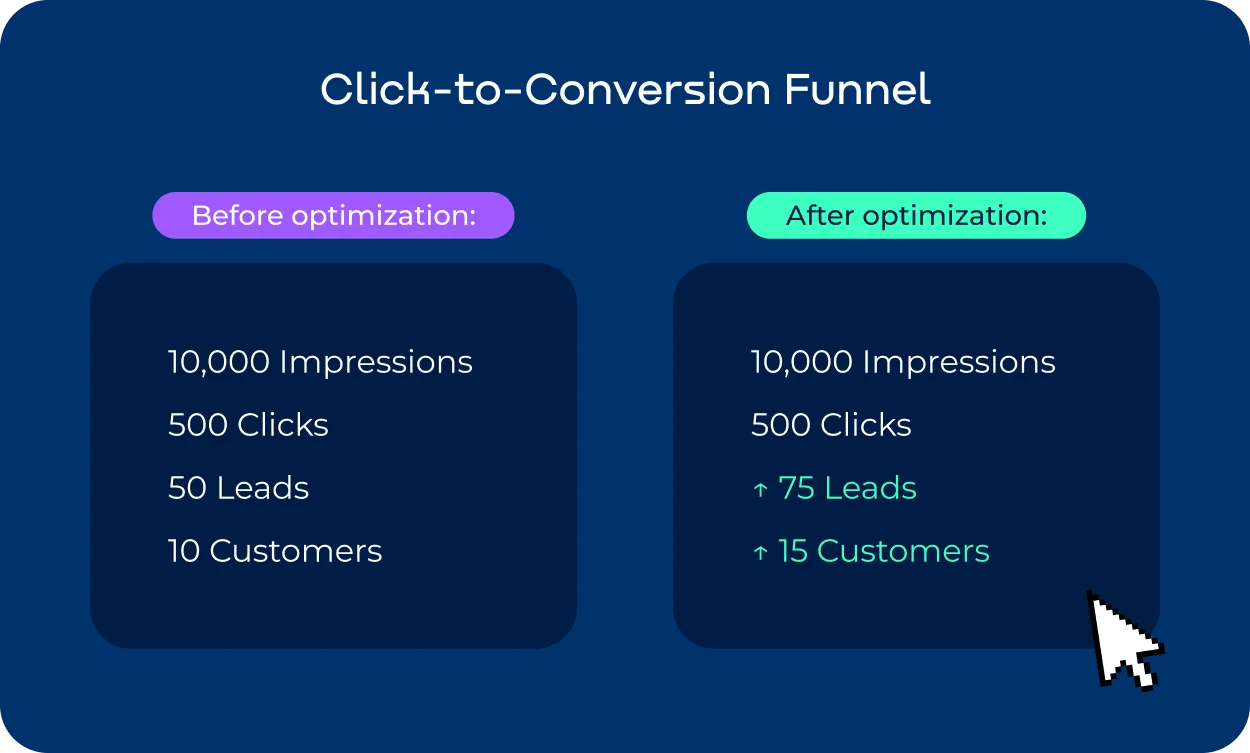
A higher bid can't compensate for a poor landing page. If users abandon the page because it loads slowly, doesn't answer their query, or asks too much too soon, increasing CPC simply makes every lost visitor more expensive.
Before increasing bids, ask:
-
• Does the landing page match the search intent?
-
• Is the expected action obvious?
-
• Would you be able to complete the conversion using a mobile device?
5. Change Bidding Strategies Only When the Data Supports It
One of the biggest mistakes is changing strategies too frequently. Every major bidding change resets the system's learning process and makes it harder to understand what actually improved performance.
As a rule, avoid switching bidding strategies unless campaign objectives, conversion tracking, or auction conditions have changed significantly.
6. Improve Relevance Instead of Simply Increasing Visibility
This is one of the PPC optimization techniques that seasoned professionals consistently recommend.
Higher Quality Scores are usually the result of better relevance, not the objective itself.
When keywords, ad copy, and landing pages consistently reinforce the same message, platforms reward that experience with stronger performance over time.
7. Test Ads Like an Experiment
Don't rewrite every headline, description, and CTA at once.
To really improve PPC ads, change one variable at a time, measure the outcome, then move to the next test. Otherwise, you'll know performance changed — but not why.
Even small improvements in conversion rate compound over thousands of clicks.
8. Prioritize Audiences, Not Just Keywords
While keywords explain what people search for, audiences explain who's searching.
Layer remarketing lists, customer lists, and in-market audiences onto your keyword strategy to focus budget on users who are more likely to convert.
9. Remove Friction from Mobile Conversions
Not every industry behaves the same on mobile. According to WordStream, sectors such as travel, hospitality, retail, restaurants, and local services typically attract a higher share of mobile search traffic, while enterprise B2B purchases often involve longer desktop research sessions. Instead of applying blanket mobile bid adjustments, review device-level performance first. A lower mobile conversion rate often points to landing page friction rather than a traffic problem.
10. Look Beyond Your Google Ads Account
Some of the biggest optimization opportunities aren't visible inside your campaign dashboard.
If competitors begin bidding on your brand name or affiliates start competing for branded traffic, acquisition costs can increase even when your campaign metrics appear stable. This is where brand bidding & PPC optimization becomes part of the optimization process.
A complete PPC strategy looks beyond bids and keywords. It also considers what's happening in the search results themselves. Monitoring competitor activity helps explain why campaign performance changes — not just that it does.
PPC Optimization Checklist
Following a consistent routine that catches problems early, improves performance, and prevents small issues from becoming expensive ones. Use the checklists below as a practical workflow — not just a list of reports to open.
Daily (5–10 minutes): Prevent Wasted Spend
Your goal is to identify anything that could waste the budget before it affects performance.
-
- Check whether yesterday's spend, conversions, and CPA are within the expected range.
-
- Review new search terms and add obvious negative keywords.
-
- Investigate campaigns with sudden changes in impressions, CTR, CPC, or conversion rate.
-
- Confirm that conversion tracking is recording events correctly.
-
- Resolve disapproved ads or other policy issues.
-
- Check that branded campaigns aren't unexpectedly losing impression share.
Weekly (30–60 minutes): Improve Campaign Performance
Use weekly reviews to make measured improvements based on enough accumulated data.
-
- Pause keywords or ads that have consistently underperformed.
-
- Promote high-converting search queries into dedicated keywords or ad groups.
-
- Review bid adjustments by device, audience, and location.
-
- Evaluate active ad tests and launch a new variation if a clear winner has emerged.
-
- Compare mobile and desktop performance to identify conversion friction.
-
- Evaluate audience and remarketing performance to uncover optimization opportunities.
-
- Reallocate budget from campaigns that consistently underperform to higher-performing ones.
Monthly (2–3 hours): Review the Bigger Picture
Step back from day-to-day management and evaluate how well your account aligns with current business goals.
-
- Audit your campaign structure and account organization.
-
- Review landing pages for page speed, message alignment, and conversion rate.
-
- Compare performance against business KPIs — ROAS, CPA, revenue, or qualified leads.
-
- Review attribution and conversion tracking to make sure reporting reflects the customer journey accurately.
-
- Analyze competitor activity, including changes in messaging, offers, and branded search visibility.
-
- Check whether competitors or affiliates have started bidding on your branded keywords.
-
- Identify one structural improvement to implement next month, such as reorganizing campaigns, testing a new bidding strategy, or expanding into a new keyword cluster.
One final recommendation: resist the temptation to optimize everything at once. After making a significant change, give the campaign enough time to collect meaningful data before drawing conclusions. Consistent, measured improvements almost always outperform constant reactive adjustments.
PPC Optimization Best Practices for 2026
The fundamentals of PPC campaign optimization haven't changed over the years, but the way advertisers optimize campaigns continues to evolve. According to industry discussions on LinkedIn and Reddit, automation is becoming more capable, while measurement and experimentation are playing a bigger role in decision-making.
1. Use Automation Strategically
Automation can save time and improve performance, but it isn't a substitute for human oversight. Smart Bidding, automatically generated assets, and AI-powered recommendations work best when conversion tracking is accurate and campaign objectives are clearly defined. Think of automation as a tool that executes your PPC strategy, not one that creates it.
2. Run Controlled Experiments Before Making Major Changes
Avoid making multiple changes at once. If performance improves or declines after that, you won't know what caused it. Instead, use Google Ads Experiments to test bidding strategies, ad messaging, landing pages, or campaign settings against a control version. Controlled testing makes optimization decisions more reliable and reduces unnecessary risk.
3. Focus on Business Outcomes, Not Vanity Metrics
A higher CTR or more impressions don't necessarily mean a better campaign. Evaluate success using metrics that reflect business performance, such as qualified leads, sales, revenue, ROAS, customer acquisition cost, or profit. These metrics provide a much clearer picture of whether your PPC campaign optimization efforts are delivering actual value.
4. Keep Optimization Goals Aligned With Business Goals
Optimization priorities should change as your business changes. A company launching a new product may prioritize visibility, while an established ecommerce brand may focus on profitability. Revisiting your goals regularly ensures that every optimization decision supports the outcomes that matter most—not just the metrics that are easiest to improve.
Common PPC Optimization Mistakes
Discussions among experienced advertisers regularly point to the same problems: neglected search term reports, outdated negative keyword lists, and poorly organized account structures. These issues can quietly drain the budget long before bid strategy becomes the limiting factor.
- • Not using search term reports: Search behavior changes constantly. If you aren't reviewing keywords, irrelevant queries can start to consume budgets.
- • Overreliance on automation: Automation is designed to optimize campaigns based on the signals it receives. If conversion tracking is inaccurate or campaign goals are unclear, automated bidding is likely to optimize for the wrong outcome. Review recommendations critically instead of applying them by default.
- • Sending traffic to generic landing pages: An ad may earn the click, but the landing page determines whether that click becomes a conversion. Generic pages that don't match the user's intent often lead to lower conversion rates and wasted ad spend.
- • Keeping too many keywords in one ad group: Large, loosely themed ad groups make it difficult to write highly relevant ads. A more focused structure improves message relevance, simplifies optimization, and can contribute to stronger Quality Scores.
PPC Campaign Optimization Myths vs Reality
Not every widely accepted PPC "best practice" holds up in real accounts. Here's a quick comparison between common assumptions and the realities experienced by PPC managers.
| PPC Myth | Reality |
|---|---|
| Higher bids always mean better results | Poor traffic can still waste budget |
| Automation fixes everything | Automation still needs oversight |
| More keywords are better | Irrelevant keywords create waste |
| CTR is the most important metric | Profitability matters more |
How Competitor Monitoring Improves PPC Optimization
Search auctions are dynamic. Competitors launch new campaigns, change messaging, adjust bids, or begin targeting branded keywords. These changes can affect your results even if you haven't modified your own campaigns.
Reviewing search results regularly helps answer important questions:
-
• Who appears alongside your ads?
-
• Have competitors changed their offers or messaging?
-
• Is someone bidding on your branded keywords?
-
• Are affiliates or resellers competing for the same branded traffic?
Without this visibility, performance changes may be attributed to the wrong cause.
For branded campaigns, monitoring is especially valuable. If affiliates or competitors start bidding on your brand name, your costs may increase even though the clicks still come from users already searching for your business.
Example of hidden PPC costs behind unauthorized activity:
| Scenario | Cost |
|---|---|
| Direct branded click | $1.20 |
| Affiliate brand bidding click | $1.20 CPC + affiliate commission |
| Estimated additional cost | 20–50%+ higher acquisition cost |
If competitor activity is affecting your campaigns, monitoring the auction environment can be just as valuable as optimizing bids or keywords.
Bluepear lets you monitor search result changes across search engines and detect advertisers bidding on your brand. Set up monitoring to identify issues early and make better optimization decisions based on what's actually happening in the SERP.

Conclusion
Every new search trend, competitor, landing page update, or bidding change creates another opportunity to improve — or another way performance can quietly decline. The best-performing PPC accounts improve consistently over time.
The three principles of effective optimization are:
-
• Base decisions on data, not assumptions;
-
• Optimize for business goals, not abstract marketing metrics alone;
-
• Monitor the competitive landscape, not just your own account.
If you combine disciplined campaign management with ongoing competitive intelligence, your optimization efforts become proactive instead of reactive. That's how you can consistently outperform competitors.
FAQ
What is PPC optimization?
It is the process of making every advertising dollar work harder than it did yesterday to generate better business outcomes from the same or lower ad spend. It needs to be performed regularly and involves varied techniques that improve PPC campaigns and their outcomes.
Why does PPC campaign optimization matter?
Markets don't stand still. Search behavior changes, competitors adjust their messaging, and advertising platforms introduce new features. Small shifts accumulate until they affect CPA, ROAS, or revenue.
PPC campaign optimization helps advertisers identify performance issues early and fix them before they negatively affect the business outcomes.
How can I improve PPC ads without increasing the budget?
Make sure you're getting the maximum value from every click you already pay for.
Work on ad relevance, test new headlines and CTAs, remove low-intent search queries with negative keywords, and send visitors to website pages that closely match their search intent. If performance still plateaus, look beyond the ad itself — changes in competitor messaging or brand bidding activity may also be influencing results.

Monitor PPC competitors