
Here we review Red Points and Bluepear and compare them as brand protection solutions, with a focus on their capabilities, key differences, and typical use cases. All the data is procured from the official websites and review platforms.
Read on for more details that will help you make an educated choice.
Red Points vs. Alternatives at a Glance
Brand protection tools differ in the channels they monitor, the types of violations they detect, and how deeply they investigate suspicious activity. Red Points solutions cover a broader range of online brand abuse, while Bluepear concentrates on paid search and affiliate marketing. Both can be relevant to search brand protection, but the right fit depends on which threats your team needs to track.
| Criterion | Red Points | Bluepear |
|---|---|---|
| Best for | Broad digital brand protection across multiple types of online abuse | Brand protection focused on paid search and affiliate marketing |
| Main strength | Wider scope of online brand protection tasks | Specialized monitoring of branded search results, paid ads, and affiliate program violations |
| Main limitation | May offer more coverage than a business needs if its main concern is branded search monitoring; fit depends on the required capabilities | Not designed to replace the full range of Red Points solutions for every type of online brand abuse |
| Choose it if | You need to address multiple forms of brand abuse across the digital environment | Your main concerns are brand bidding, PPC ad hijacking, and affiliate rule violations |
This comparison reflects the platforms' overall focus, not a verdict on their performance in overlapping areas. Specific capabilities and coverage should be verified against the current product offering, plan, and configuration.
Looking for more options? Check out what other brand monitoring tools we reviewed.
What Is Red Points: a Review of Its Brand Protection Solutions
Digital brand protection is the process of detecting and addressing the unauthorized use of a brand across online channels. Red Points provides an AI-powered platform that helps companies identify digital brand abuse and take action against it, combining automated detection with enforcement workflows and specialist support.
According to current product pages, the main Red Points solutions include the following:
-
• Anti-counterfeiting and marketplace protection. Detects potentially infringing product listings and sellers across marketplaces, including Amazon, Alibaba, eBay, Walmart, Etsy, and Temu. The platform supports automated takedown workflows for confirmed infringements.
-
• Impersonation removal and domain management. Targets fake websites, phishing pages, copycat stores, fraudulent social media profiles, and domains misusing a brand's identity. Domain management also covers detecting and reclaiming domains that exploit a brand name.
-
• Ad protection and search engine monitoring. Targets fraudulent or infringing ads, while search engine monitoring can identify infringing content and websites for potential removal or deindexing.
-
• Gray market protection. Identifies unauthorized sellers and parallel imports, helping brands enforce distribution policies and address sales outside their authorized channels.
-
• Anti-piracy and digital rights protection. Helps identify and remove pirated content across relevant online channels. Also offers social video growth and copyright-related services for protecting and managing digital content.
The platform combines automated detection with enforcement, including takedown workflows, platform integrations, and support from intellectual property specialists. Its offering also includes additional services such as online investigations, test purchases, and seller notices.
This kind of platform can be useful for ecommerce businesses, consumer brands, and larger companies managing intellectual property across multiple markets. It uses AI to identify potential infringements and supports their removal, while reporting helps teams track enforcement activity and assess results.
Red Points vs. Bluepear: Key Differences
These platforms overlap in search advertising protection, but their broader product focus and monitoring workflows differ. The comparison below focuses on the areas most relevant to search brand protection.
1. Scope of Protection: Broad Online Brand Protection vs. Search-Focused Monitoring
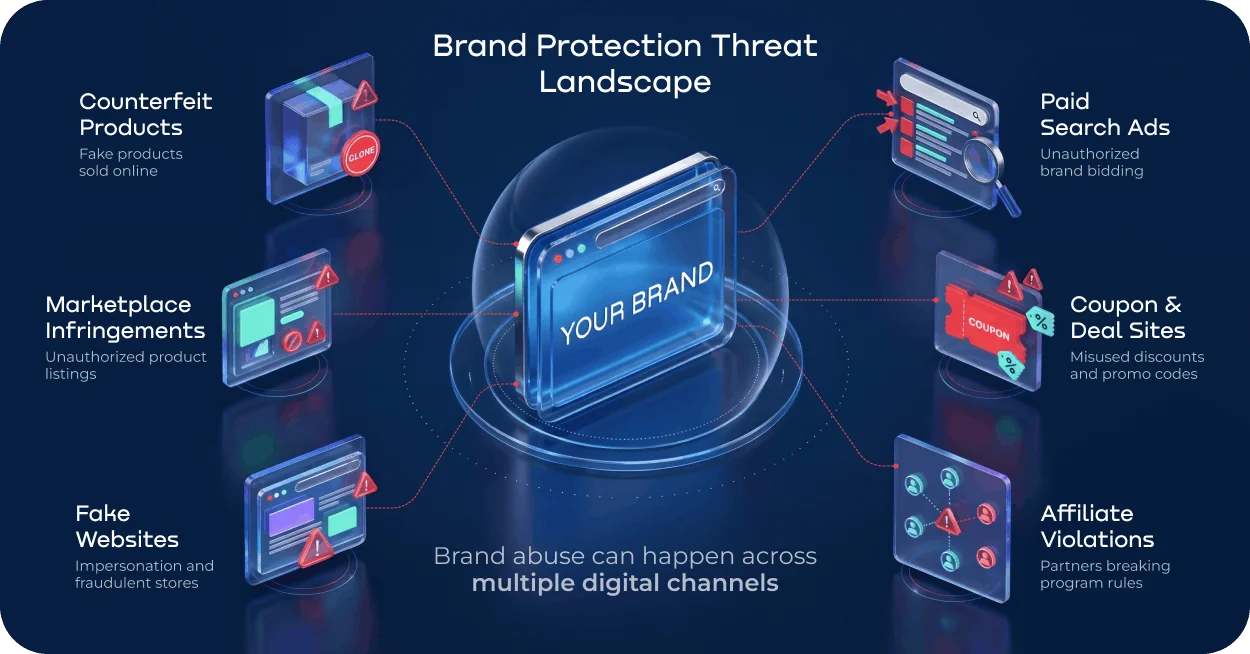
Red Points covers a broad set of digital brand threats, including counterfeit listings, impersonation, infringing websites, fraudulent ads, and unauthorized use of intellectual property. Its published solutions span marketplaces, websites, domains, social media, search engines, and advertising. This breadth can suit companies dealing with several types of online abuse across different markets. The precise coverage depends on the selected solution and should be checked against the current product offering.
Bluepear focuses on paid search and affiliate marketing. Its product suite includes Brand Bidding Protection, Ad Hijacking Detection, Coupon Code Monitoring, Affiliate Content Monitoring, Competitor Monitoring, and an Uncloaking Tool. These tools help teams investigate branded search results, paid ads, landing pages, affiliate activity, and suspicious redirects. Bluepear is therefore a more specialized option for teams whose main concern is what happens around branded search traffic.
The choice comes down to the range of threats you need to cover. A brand dealing with counterfeits and impersonation alongside ad abuse may need Red Points' broader coverage; a team focused on paid search and affiliate compliance may prefer Bluepear's more specialized monitoring.
2. Brand Bidding and PPC Ad Hijacking Detection
PPC ad hijacking refers here to the misuse of advertising or affiliate traffic infrastructure to divert paid clicks, intercept branded search demand, or redirect users in ways that violate an advertiser's rules. Both platforms address aspects of ad-related brand abuse.
Red Points offers an Ad Protection solution that detects and removes fraudulent or infringing ads on search engines and social media. The platform describes 24/7 monitoring, reporting, and built-in workflows for taking action against infringing ads. That makes it relevant to brands investigating unauthorized advertising, although the exact depth of brand-bidding and redirect analysis should be confirmed for the proposed setup.
Bluepear focuses more directly on branded search activity and affiliate-related PPC violations. Its monitoring can capture:
-
• Ads appearing for monitored brand keywords, including ad text, titles, and creatives.
-
• Landing pages and affiliate links associated with suspicious ads.
-
• Redirect chains and affiliate identifiers, including cases where the final destination differs from the initial URL.
-
• Screenshots and contextual data such as location, device, operating system, browser, and time of detection.
This helps PPC and affiliate teams investigate who is bidding on branded terms, whether an ad breaches program rules, and where a click actually leads. The collected evidence can support a complaint or a decision about affiliate commissions; the team still needs to review the case and decide what action to take.
For a company looking specifically for PPC brand protection, compare the exact checks each vendor performs. Ad detection and takedown are useful, but they are different from tracing an affiliate click through redirects or examining the identifiers used along the way. Neither platform should be assumed to cover every investigative step without confirmation.
Read our article on affiliate brand bidding for more context on what it is and how it may affect your business.
3. Affiliate Marketing Compliance and Coupon Monitoring
Affiliate compliance means ensuring that partners follow the terms of an affiliate program, including restrictions on brand bidding, ad copy, traffic sources, and promotional codes.
Red Points identifies partner violations as one of the problems its Ad Protection solution addresses. That is relevant when an affiliate publishes an unauthorized or infringing ad. However, its public product information does not establish that every affiliate compliance workflow — such as dedicated coupon misuse monitoring or detailed affiliate-ID tracing — is included in every configuration. Those requirements should be verified with the vendor.
Bluepear offers tools built around these specific affiliate marketing concerns:
-
• Brand bidding monitoring: identify affiliates using branded keywords in paid search.
-
• Coupon code monitoring: investigate misuse of promotional codes, including cases where affiliates claim credit for customers who were already likely to convert.
-
• Affiliate content monitoring: review partner content and advertising activity for potential violations.
-
• Ad and redirect investigation: connect suspicious ads with landing pages and affiliate tracking information.
These capabilities give affiliate managers evidence they can use to investigate suspected violations, contact partners, submit complaints, or challenge commissions under their program rules.
If your problem is a mix of counterfeit listings, fake profiles, and infringing websites, a broader brand protection platform may be appropriate. If recurring issues involve brand bidding, coupon abuse, and partners diverting branded traffic, Bluepear's specialized monitoring is more directly aligned with those tasks.
4. Monitoring, Evidence, and Day-to-Day Workflow
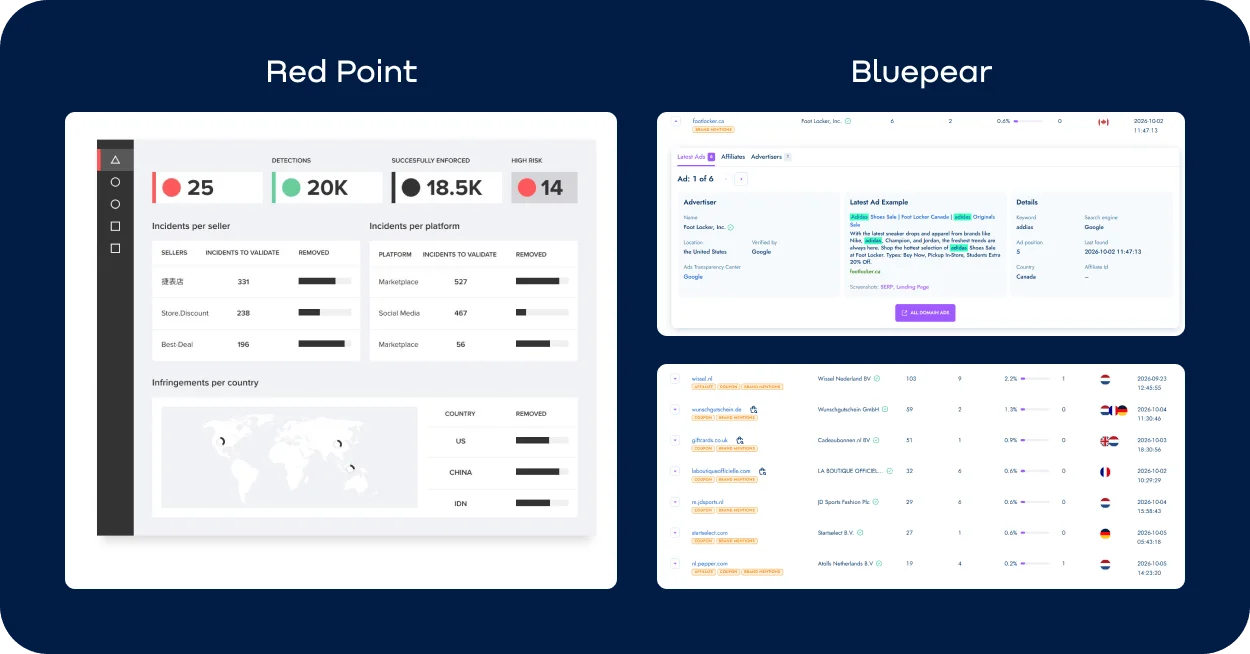
| Criterion | Red Points | Bluepear |
|---|---|---|
| Monitoring coverage | Multiple channels, including search engine ads, websites, marketplaces, and social media | Paid ads, organic search results, branded keywords, and affiliate-related activity |
| Geographic coverage | Ad protection advertised across countries and territories | Monitoring across the world, with checks by device type and time |
| Evidence | Detection records and reporting for infringing ads; specific evidence fields depend on the solution | Screenshots of search results and landing pages, ad copy, URLs, and redirect information |
| Reporting | Reports and dashboards, including reporting on ad protection activity | Violation reports and alerts to Slack to help teams investigate and act |
| Enforcement | Built-in workflows for reporting and removing fraudulent or infringing ads | Evidence collection to support complaints and follow-up by the advertiser or affiliate team |
| Setup and access | Demo-led sales process; confirm onboarding and configuration for the selected solution | Self-service SaaS with a free trial; confirm the setup requirements for your monitoring scope |
Red Points emphasizes large-scale detection and enforcement, including direct platform connections and takedown workflows. Bluepear emphasizes search-level evidence: which ad appeared, where it appeared, what the user would see after clicking, and which affiliate tracking details may be involved. Both approaches can support investigations, but they serve somewhat different operational needs.
Before choosing either platform, ask vendors to demonstrate a real case relevant to your team. For example, have them show how they would investigate an affiliate bidding on your brand name, displaying an unauthorized discount, and redirecting visitors through a tracking chain. Check which evidence is captured automatically, which steps require manual review, and what options exist for reporting the violation. That will tell you more about day-to-day fit than a feature list alone.
Which Product Fits Your Use Case?
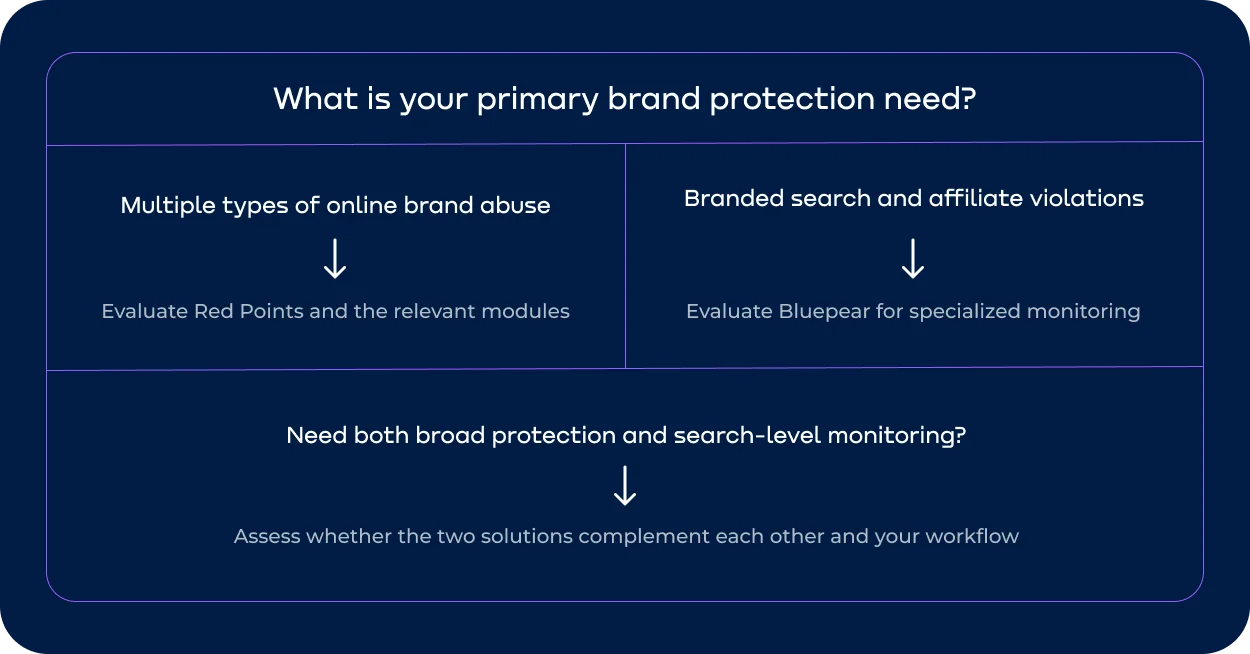
Choose Red Points If…
Red Points may be a better fit if your company:
-
• Needs protection against several forms of online brand abuse, from counterfeit products and impersonation to infringing ads and unauthorized sellers.
-
• Manages brand protection across multiple digital channels and markets.
-
• Wants to coordinate detection and enforcement across a broader set of intellectual property and brand misuse issues.
-
• Evaluates software based on its overall brand protection coverage, rather than search advertising alone.
This is particularly relevant for ecommerce businesses and established consumer brands dealing with different kinds of infringement at once. Before committing, confirm which solutions, channels, and enforcement workflows are included in the proposed package and whether they meet your team's requirements.
Choose Bluepear If…
Bluepear is worth considering if your main concerns sit closer to paid search and affiliate marketing. It may suit your team if you:
-
• Need to monitor ads appearing against your own brand keywords and investigate suspicious activity in branded search results.
-
• Suspect competitors or affiliates are bidding on your brand in ways that violate your trademark or affiliate program rules.
-
• Need to investigate coupon code misuse, unauthorized promotional claims, or other affiliate compliance issues.
-
• Want to trace suspicious redirects and examine landing pages, ad copy, and affiliate tracking identifiers.
-
• Need to monitor search results across different locations, devices, and times to see how ads and partner activity vary.
-
• Prefer a specialized self-service SaaS tool that lets your team configure monitoring and review evidence directly.
These use cases are especially relevant to PPC managers tracking CPC and campaign performance, affiliate managers investigating partner violations, and compliance teams collecting evidence for follow-up.
Conclusion: Is Bluepear a Good Red Points Alternative?
Bluepear can be a good alternative solution for search brand protection, provided your main concerns are branded search advertising, brand bidding, PPC ad hijacking, and affiliate program violations. Its specialized monitoring is designed around these tasks, including the investigation of suspicious ads, landing pages, and redirect chains.
Red Points is worth considering when your business needs broader digital brand protection across multiple types of online abuse, from counterfeit products to impersonation and infringing content. And if you’re already using the platform, evaluating Bluepear as a complementary tool may make more sense than switching your entire brand protection setup.
Ultimately, choose based on the channels you need to monitor, the evidence your team needs, and the actions each platform supports.
To test Bluepear against your branded keywords and target markets before committing, sign up for a free trial here.

FAQ
Is Bluepear a direct alternative to Red Points?
It depends on your needs. Bluepear focuses on paid search and affiliate monitoring, including brand bidding, PPC ad hijacking, and coupon code misuse. It may be a suitable alternative for specific search protection needs, but it does not replace the full scope of Red Points solutions.
Is Red Points suitable for brand bidding monitoring?
The platform offers ad protection and monitors advertising across search engines and other channels. However, the availability and depth of specific brand bidding checks should be confirmed against its current product documentation and proposed configuration. If you need detailed analysis of branded search ads, affiliate identifiers, or redirect chains, ask the vendor to demonstrate those workflows.
Can Bluepear and Red Points be used together?
Yes, using both may make sense when a company needs broad online brand protection alongside specialized monitoring of paid search and affiliate activity. Red Points can address a wider range of digital brand abuse, while Bluepear can support investigations into branded search ads and affiliate violations. Before adopting both, compare their overlapping features, total cost, and reporting workflows to avoid paying twice for the same coverage.

Test Bluepear for brand protection — free trial