
Contents
According to the 2025 Internet Advertising Revenue Report by IAB, PPC advertising remains the largest segment in the marketing industry, holding 39.8% of market share. It’s no wonder PPC is also very competitive: 87% of industries saw an increase in their CPCs in 2025, according to WordStream’s Benchmarks. In this landscape, staying aware of competitor activities is instrumental for success. The alternative is wasting your marketing budget and missing out on valuable revenue. In this guide you’ll find the best tools and tips for search ad monitoring. Learn how to stay in control and keep track of industry benchmarks, market shares, and brand bidding in PPC marketing.
What is Search Ad Monitoring?
It’s an ongoing collection and analysis of competitor search ads data with the goal of improving your own PPC strategy.

The key steps in search advertising monitoring are:
- 1. Tracking competitor ads
- 2. Analyzing data
- 3. Optimizing your strategy
What problems does competitive ad monitoring solve?
- • Inefficient marketing decisions: PPC competitor analysis ensures data-based decisions — a baseline requirement for successful advertising.
- • Lost traffic and conversions: Analysis shows when competitors are outperforming you and actively targeting your brand terms.
- • Unclear benchmarks: Competitor data answers the question of what budget spend and performance metrics are normal for your niche, allowing you to confirm whether the results you’re getting are adequate.
- • Gaps in ad campaigns: Competitor search ads provide case studies of advertising products similar to yours, giving you ideas for fine-tuning your own messaging and marketing tactics.
Why Tracking Competitor Search Ads is a Game-Changer
Wondering why other companies’ ads always seem to outperform yours or get more clicks? The secret lies in competitor advertising monitoring at work.
With the right tools you can:
- • spot new high-performing keywords to use in your campaigns
- • analyze ad copy across your industry: CTAs, pain points, and offers
- • benchmark performance metrics and budget spend
- • flag competitors that target your brand terms
- • detect ad hijacking: affiliates or competitors redirecting traffic from your ads
Ignoring PPC data leaves you vulnerable to:
- • Brand Hijacking. Competitors bidding on your trademarked terms.
- • Creative Theft. Others replicating your best-performing ads.
- • Strategy Leaks. Rivals reverse-engineering your entire approach.
The most experienced advertisers use insights from competitor search ads not to copy, but to innovate — identifying white spaces where they can differentiate. This approach transforms what could be imitation into proactive strategy development. By maintaining balance, you position your brand to lead rather than follow in the competitive environment.
Best Tools for Competitive Ad Monitoring
Recommended features to look for:
- • Real-time alerts. Instant notifications to immediately detect threats, like new competitors or someone using your brand name in a way that breaks Google Ads trademark policy.
- • Historical data. An archive of past campaigns to identify changes that lead to measurable improvements and track seasonal changes.
- • Automated reports. Scheduled, shareable reports that simplify communication with affiliate or management teams and support enforcement actions in case of trademark abuse.
| Tasks | Best Tools |
|---|---|
| Keyword research | SEMrush, SpyFu, iSpionage, Ubersuggest |
| Competitor ad copy & history | SEMrush, SpyFu, WhatRunsWhere, PPC.io |
| Display & media ad insights | WhatRunsWhere, Adbeat |
| Auction & ad performance insights | Google Ads Auction Insights |
| Traffic & spend estimation | SimilarWeb, Wask |
| Brand protection & ad hijacking monitoring | Bluepear |
Bluepear is built for advertising monitoring and brand protection across PPC platforms and search engines.
It supports marketing teams by:
- • Automatically detecting brand bidding
- • Uncloaking ad hijacking and revealing unauthorized use of brand terms
- • Providing evidence, alerts, and proof for easier enforcement
Bluepear gives continuous visibility into who is competing for your branded traffic — and whether they are playing by the rules. It’s the recommended tool for those who need a quick and easy-to-use solution for detecting brand bidding and trademark abuse. Register an account and create a project, and Bluepear will start scanning competitor search ads immediately.

How to Monitor Competitor Ads Effectively
Below is a step-by-step plan for establishing an effective search ad monitoring workflow with tips for automation.
1. Identifying competitors
In paid search, competitors are defined by auction overlap. Any advertiser appearing for the same queries is competing for the same user attention.
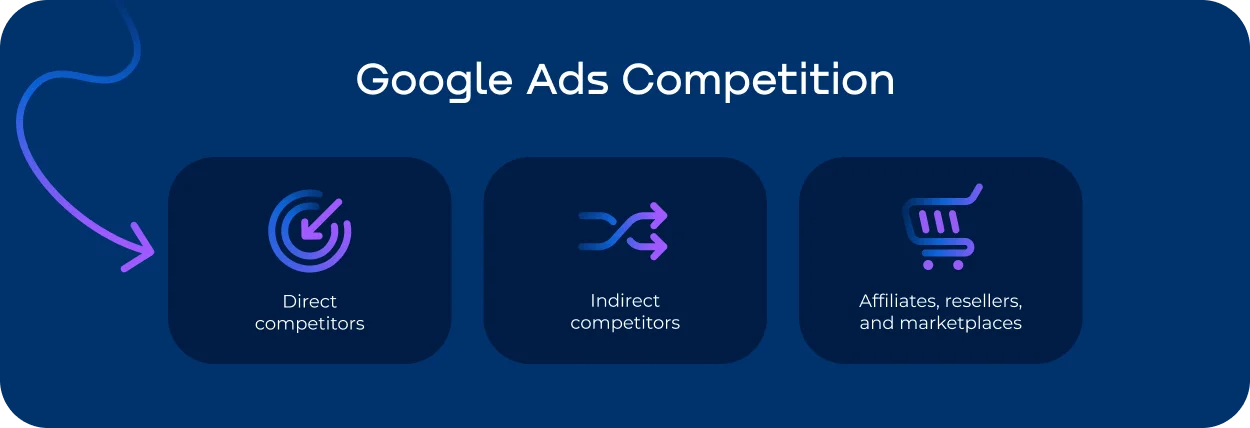
**PPC competition consists of: **
-
• Direct competitors: Businesses reaching for the same audience and competing for high-intent, conversion-focused keywords. They typically offer similar products or services and consistently appear for the same search queries.
-
• Indirect competitors: Even though they do not offer products identical to yours, they still increase auction pressure and drive up costs on shared keywords. Some examples are: alternative solutions addressing the same problem, aggregators or comparison platforms, and brands targeting broader or adjacent intent.
-
• Affiliates, resellers, and marketplaces: If not monitored, these advertisers can cannibalize traffic, distort performance data, and violate brand or affiliate agreements.
To build an effective ad copy monitoring setup, focus on keyword groups that attract competitive activity:
- • Brand keywords: Your brand or product names, and trademarked terms.
- • High-intent commercial keywords: Queries closely tied to purchase or sign-up decisions.
Monitoring these keyword sets ensures visibility into both competitive pressure and potential compliance risks.
2. Defining metrics and KPIs
The main metrics to track are:
- • Impressions — how many views ads potentially get
- • Clicks — how many users click on ads
- • Click-Through Rate — the clicks to impressions ratio
- • Cost Per Click — how much money the company spends on ads before getting a click (on average)
- • Conversions — how many clicks lead to the desired action
- • ROAS — return of investment in ads
You should also analyze:
- • Keywords to find high-performing terms you’re not using yet
- • Messaging to determine how your ads look compared to other offers
- • Landing pages to compare and see if there’s room for improvement on your LPs
- • Targeting to reference budget distribution for different segments of your audience
3. Choosing tools and automation setup
Google Auction Insights is the basic tool for competitive ad monitoring. It doesn’t reveal the actual data on CPA or competitor budget spend, but it shows who outbids you and how often it happens:
- • Impression Share: The % of potential views your ads get compared to competitors.
- • Overlap Rate: How often other ads targeting the same keywords are shown alongside yours.
- • Position Above Rate: How often competitor ads are displayed higher than yours.
- • Top of Page or Absolute Top of Page: How often your ads take the top spot in search results.
To reveal more information you’ll need the specialized tools:
- • Keywords, historical data, messaging, and landing pages, as well as an estimate of ad budget and traffic can be found in SEMrush, SpyFu, iSpionage, or Serpstat.
- • To find who’s bidding on your brand terms and detect trademark infringements use Bluepear or similar tools.
4. Scheduling reports and alerts
Manual checks or occasional reviews are not enough to keep up with fast-moving Google Ads auctions. If ad copy monitoring is not automated, teams react too late, after CPC has increased or branded traffic has already been lost. The table below shows which tools provide search ad monitoring capabilities and automate the paid search monitoring with scheduled reports and customisable alerts.
markdown
| Task | Tools |
|---|---|
| Impression share and position | Google Auction Insights |
| New competitor appearance | Google Ads |
| Rising competition on keywords | SEMrush / SpyFu |
| New ad texts | SEMrush / SpyFu |
| Landing page changes | iSpionage / custom solutions |
| Brand bidding | Bluepear |
How to Optimize PPC Ads Based on Competitor Analysis
1. Adjusting Bids
When you monitor search ads, you get an understanding of how much other companies in your niche bid, when, and on which keywords. Their metrics can help you avoid relying on guesswork and optimize your ad spend:
- • React to auction pressure: Increase bids on high-value terms and work on quality score when competitors start outbidding you.
- • Identify overbidding: Lower bids on keywords and segments where you consistently overpay.
- • Protect branded traffic: Ensure your brand terms remain visible even if competitors attempt brand bidding.
2. Identifying Winning Ad Copy Formulas
The goal here is not to copy but to understand what appeals to your audience and adapt it without breaking the rules of the platform:
- • Analyze messaging: See which headlines and CTAs seem to lead to better results and metrics.
- • Study promotional tactics: Observe discounts, urgency cues, or unique selling propositions that outperform your offers.
- • Test and adapt: Run an analysis to understand patterns and use the insights to refine your own ad copy and overall messaging.
3. Optimizing Campaign Segmentation
Data from competitive ad monitoring may help you move budget to more promising campaigns and segments:
- • Keyword-level segmentation: Allocate budget differently for high-intent vs. exploratory search terms.
- • Audience targeting: Identify what audience segments competitors frequently and successfully target, and test whether similar segments yield better conversions for you.
- • Regional and device-specific campaigns: Detect where competitors dominate geographically or on certain devices and adjust your bids or messaging accordingly.
4. Cross-Reference With Organic Performance
By combining PPC and SEO insights, you get a complete view of the competitive landscape, enabling smarter decisions that maximize reach and conversions across channels.
- • Keyword overlap: Identify high-performing keywords that competitors use in both SEO and paid search.
- • Content opportunities: Analyze competitor messaging to enrich your content strategy and optimize landing pages.
Case Studies of Competitive Ad Monitoring
TechGuru Electronics
TechGuru Electronics, a small e-commerce retailer of consumer electronics, was facing poor performance from its PPC advertising despite high spending. The company conducted a detailed PPC competitor analysis using specialized tools. Based on the data, TechGuru updated its PPC ads, reworked landing pages, and shifted its budget toward more effective keywords and time frames. Over the following three months, these changes drove a 60% increase in CTR, a 40% boost in conversions, a 35% rise in ROI, and, as an added bonus, a 20% increase in organic traffic thanks to the improved landing pages.
RevenueLab
RevenueLab, a global affiliate network, used Bluepear to monitor search ads and detected a competitor using its trademarked name in their ad texts, leading to brand confusion and traffic loss for RevenueLab. Using reports and screenshots from Bluepear as evidence, they prepared and submitted formal complaints both to the infringing competitor and to Google Ads’ trademark policy team. After the warning, the competitor removed the offending ads. As a result, the company protected their trademark, brand reputation and traffic integrity.
Conclusion: Why Regular Search Ad Monitoring is Essential
By continuously tracking competitor activity, advertisers gain the clarity needed for data-driven decisions, protect their branded traffic, and uncover new growth opportunities. When combined with automation and alerts, monitoring shifts from reactive analysis to proactive control.
The most resilient PPC strategies don’t rely on assumptions. They rely on visibility, evidence, and consistent competitive insight — turning search ad monitoring into a long-term advantage.
FAQ
What does Google Ads monitoring do?
- • Reveals competitor offers, CTAs, and keywords;
- • Identifies brand bidders and ad hijackers;
- • Prevents creative theft and misuse of your ad messaging;
- • Provides data for smarter bidding tactics and ad campaign optimization. Consistent monitoring transforms competitor insights into a roadmap for better marketing performance and brand protection.
How can businesses monitor search ads effectively?
Use different automated PPC intelligence tools to reveal more data and see the full picture. Platforms like SEMrush and SpyFu obtain keyword and ad data — but not cloaked or time-limited ads that quietly drain your performance. Bluepear provides the protection your branded campaigns need: it continuously scans organic and paid search results, captures screenshots and redirect chains, and flags any unauthorized ads and trademark violations. This gives you verified, actionable evidence across all markets.
Is it wrong not to monitor competitor or affiliate ads?
Without active advertising monitoring, brands face:
- • Trademark abuse — competitors running ads with your name or logo;
- • Ad hijacking — affiliates redirecting your traffic for commissions;
- • Budget inflation — CPCs rising from hidden competition on branded queries;
- • Loss of credibility — fake ads misleading your customers. Bluepear helps eliminate these blind spots with 24/7 visibility and automated alerts.
How can companies use ad monitoring insights strategically?
Treat competitor data as fuel for optimization and improvement, not for imitation. Use it to identify ad angles that perform well, adjust your bidding tactics, test stronger CTAs, and close keyword gaps. Pair these insights with Bluepear’s brand-protection layer to remove harmful ads, file trademark complaints, and ensure your brand dominates its search space ethically and efficiently.

Monitor Brand Bidding in PPC