
Contents
We made this guide useful for compliance specialists, in-house legal teams, and marketers responsible for affiliate programs and commercial performance. In it, we’ll share Bluepear’s expertise on what trademark monitoring service actually covers and which databases and tools can help track potentially conflicting activity. We’ll also cover misuse across digital marketing channels and look at notable legal disputes.
What is Trademark Monitoring?
To put it simply, it is a process of regularly checking trademark databases and relevant digital channels for potentially conflicting applications, registrations, or unauthorized use of a brand's assets.
A narrowly focused setup may monitor only trademark registries for identical or similar marks. A broader approach combines registry monitoring with digital trademark monitoring — tracking how the brand assets are used across online channels.
| Monitoring area | What to monitor | What trademark monitoring software can detect | Example signal | Why it matters |
|---|---|---|---|---|
| Trademark registries | Applications, registrations, and status changes | Similar or potentially conflicting marks | Similar mark filed | Early identification of potential conflicts |
| Search engines | Brand mentions and organic results | Unauthorized or misleading brand use | Unofficial website ranks for brand terms | Brand visibility and consumer confusion |
| Paid ads | Brand names in ad copy and keywords | Trademark bidding and unauthorized advertising | Affiliate bids on your brand name | Traffic diversion and PPC risk |
| Marketplaces | Brand names, products, and listings | Unauthorized listings and counterfeit products | Fake branded product listed | Revenue, reputation, and consumer protection |
| Websites | Brand names, logos, and content | Brand impersonation or unauthorized commercial use | Website presents itself as an official brand site | Reputation and consumer trust |
| Social media | Brand references, profiles, and promotions | Unauthorized brand use or promotion | Account uses brand identity without authorization | Consumer confusion and reputation risk |
| Domains | Brand-related domain registrations and use | Cybersquatting and suspicious domains | Domain closely resembles the brand’s name or unique product | Phishing, impersonation, and traffic diversion |
What is a Trademark Monitoring Service?
A trademark monitoring service is an ongoing system that repeatedly checks selected sources and alerts of potentially relevant changes. This matters because new applications, registrations, and instances of brand misuse can emerge long after the initial search.
In practice, trademark monitoring can cover two layers:
- 1. Registries — newly filed or published marks, registrations, status changes, and potentially similar trademarks in relevant jurisdictions.
- 2. Digital channels — the use of brand name and assets by affiliates and third parties online.
The goal is to surface potentially relevant activity early enough for a compliance or legal team to investigate.
Official Trademark Databases

USPTO is the key source for trademark monitoring in the US. Its Trademark Status & Document Retrieval (TSDR) system provides access to trademark application and registration records, including status, documents, owners, filing information, classes, and goods and services.
For the European Union, EUIPO provides several relevant resources. eSearch plus gives access to EU trademark information, while TMview brings together trademark data from participating national, regional, and international offices. EUIPO also provides monitoring and alert functionality for potentially conflicting EU trademark applications.
For international work, WIPO offers the Global Brand Database and Madrid System tools. The Global Brand Database searches trademark collections from WIPO and participating national and regional offices. WIPO also recommends checking national or regional registers because its global database does not contain every local filing.
WIPO's eMadrid environment now includes Find and monitor, where users can look up international registrations, check their status across designated Madrid System members, and create watchlists. Madrid Monitor remains available as a legacy tool while its functionality is being integrated into eMadrid.
| Tool / source | Geographic focus | Best for |
|---|---|---|
| USPTO | United States | US trademark records |
| EUIPO eSearch plus | European Union | EU trademark records and alerts |
| EUIPO TMview | International / participating offices | Cross-office searches |
| WIPO Global Brand Database | International | Multi-jurisdiction searches |
| WIPO eMadrid | Madrid System | International registrations |
These resources are useful, but they do not necessarily tell you who is using your brand in a Google ad, copying your messaging on a website, or promoting counterfeit products on a marketplace.
Digital Trademark Monitoring Tools
A few examples illustrate the range:
| Tool | Primary focus | What it monitors / detects |
|---|---|---|
| Bluepear | Branded search and affiliate compliance | Paid and organic search activity, brand bidding, ad hijacking, trademark misuse, affiliate violations, landing pages |
| BrandVerity | Paid search and partner compliance | Trademark-infringing ads, branded keywords, affiliate activity, ad copy, display URLs and partner violations |
| Clarivate CompuMark | Trademark watching and web watching | Global trademark registers, similar marks, online trademark use, domains and potential misuse |
| Corsearch | Trademark watching and broader brand protection | New trademark filings, marketplaces, social media, domains and other online threats |
| Markmonitor | Domain and online brand protection | Third-party domains containing brand terms, domain threats, risk signals and enforcement workflows |
Note: Trademark monitoring tools identify potentially relevant activity and online brand misuse. They do not replace legal advice from a qualified attorney.
As you can see, trademark monitoring tools take different approaches. Some focus primarily on trademark filings. Others are built around online brand misuse, paid search, domains, marketplaces, or other digital channels. Before choosing a tool, define the threat you actually need to see. A legal team watching trademark filings in 20 jurisdictions has very different requirements from a marketing team trying to catch affiliates bidding on branded keywords.
Click the link to read our guide on → brand keyword monitoring for affiliate and compliance teams.
Why are Trademark Monitoring Services Important for Businesses?
Trademark conflicts can become expensive quickly. They consume legal resources, management time, and attention that could have been spent elsewhere.
In Hermès International v. Rothschild, the creator of “MetaBirkins” sold NFT images based on the Birkin bag and used the MetaBirkins name and domain. The NFTs generated more than $1 million in sales. After a nine-day trial, a federal jury found trademark infringement, dilution, and cybersquatting and awarded Hermès $133,000 in damages.
A good example of how persistent trademark conflicts can become is the long-running dispute between Apple Inc. and the Beatles’ company Apple Corps. The companies first went to court over the “Apple” name in 1978 and continued to have disputes for almost three decades. Their 2007 settlement ended the ongoing lawsuit, with Apple Inc. taking ownership of the relevant trademarks and licensing some of them back to Apple Corps.
Most businesses would prefer to identify and resolve any issues before litigation becomes necessary. Trademark monitoring services are designed to identify a potential conflict or potential infringement before it becomes a large commercial or legal problem.
Read our article → “Trademark Infringement Reporting” to see how you can spot and solve the problem.
What Does a Trademark Monitoring Service Track?
Registries
The traditional side of trademark monitoring involves keeping track of official trademark registers for potential conflicts.
This can include:
- • Identical marks — applications or registrations that match your trademark.
- • Similar marks — confusingly similar names, logos, or other signs.
- • New applications — recently filed marks that could become relevant to your business.
- • Registrations — newly registered trademarks that may affect your market position.
- • Status changes — updates such as publication, registration, opposition, cancellation, etc.
- • Goods and services — whether the mark covers products or services that overlap with yours.
- • Classes — the Nice Classification classes connected to the application or registration.
- • Applicants and owners — who is behind the mark and whether the owner is a known partner, competitor, or unrelated party.
Similarity by itself does not make a trademark problematic. Context is what makes an alert worth investigating. A nearly identical mark for an unrelated type of product may be irrelevant, while a less obvious similarity in a directly competing category could deserve immediate attention.
Official databases are therefore a core part of a trademark monitoring service. For example, the USPTO provides US trademark records through TSDR, while EUIPO and WIPO offer search and monitoring resources covering EU and international trademark activity.
Digital Channels
Digital trademark monitoring can be used to uncover unauthorized use of brand assets in:
- • Search engines
- • Paid search ads
- • Websites
- • Marketplaces
- • Social media platforms
- • Domains
For a brand operating heavily through digital channels, watching the register alone leaves a sizable blind spot. The practical approach is to connect this layer with digital channels monitoring. Together, they give legal, compliance, and marketing teams a much clearer picture of where a potential issue starts and whether it deserves further investigation.
For detailed information on tracking brand assets in digital channels, go to our article on → digital trademark monitoring.
How Does Trademark Monitoring Work?
The goal of trademark monitoring is to identify new filings, registrations, and uses that could potentially lead to a conflict — and surface them early enough to do something about them.
Therefore, the practical workflow usually looks like this:
Step 1. Define What to Monitor
A conflicting mark rarely arrives with a neat copy of your exact trademark. It may differ by one letter, use a similar-sounding name, or appear in a different class that still overlaps with your commercial activity.
Your monitoring scope can therefore include:
- • Brand names and registered trademarks;
- • Logos and other protected visual elements;
- • Common spelling variations and typos;
- • Abbreviations, transliterations, and phonetic variations;
- • Key product or service names;
- • Relevant classes;
- • Competitor trademarks, where they matter to your market or enforcement strategy.
Step 2. Select Jurisdictions and Channels
Decide where a conflict would matter. This usually means the regions where you sell, advertise, manufacture, or aim to expand your presence.
For trademark monitoring in the US, for example, the USPTO provides access to federal applications and registrations as well as tools for searching similar marks.
For portfolios that include several countries, WIPO's database allows searches across multiple national and regional collections, while its Madrid tools cover international registrations.
You also need to choose which digital channels to watch. Anywhere your mark can realistically be used commercially is a good basis.
Step 3. Run Recurring Searches
Searches can be scheduled daily, weekly, or at another frequency appropriate to the brand and jurisdiction.
The frequency matters. If a potentially conflicting application is discovered months after publication, the available response options may be narrower than they were when the filing first appeared.
Trademark monitoring software can automate searches and compare new records against your monitoring criteria.
Step 4. Detect Potentially Relevant Results
Simple exact-name searches are rarely enough. More sophisticated trademark monitoring tools can combine text matching with phonetic, conceptual, or image similarity and filter results by jurisdiction, status, class, applicant, or other criteria.
Step 5. Filter False Positives
Sometimes, a similar trademark is not a threat. The same word may belong to an unrelated company, cover completely different goods, or exist in a market where your business has no presence.
Filtering should consider factors such as:
- • Similarity of the marks;
- • Goods and services;
- • Nice classes;
- • Jurisdiction;
- • Applicant or owner;
- • Commercial overlap;
- • Likelihood of confusion.
Step 6. Review and Prioritize Alerts
For example, a newly filed mark that closely resembles your brand, covers overlapping services, and targets one of your core markets deserves a very different response from an unrelated mark with a coincidental name.
Human review is critical here. The legal or IP team may need to verify the underlying record, assess the scope, check procedural deadlines, and decide whether to oppose, challenge, contact the applicant, or simply keep the case under observation.
What Should You Do When Your Trademark Monitoring Service Finds a Potential Conflict?
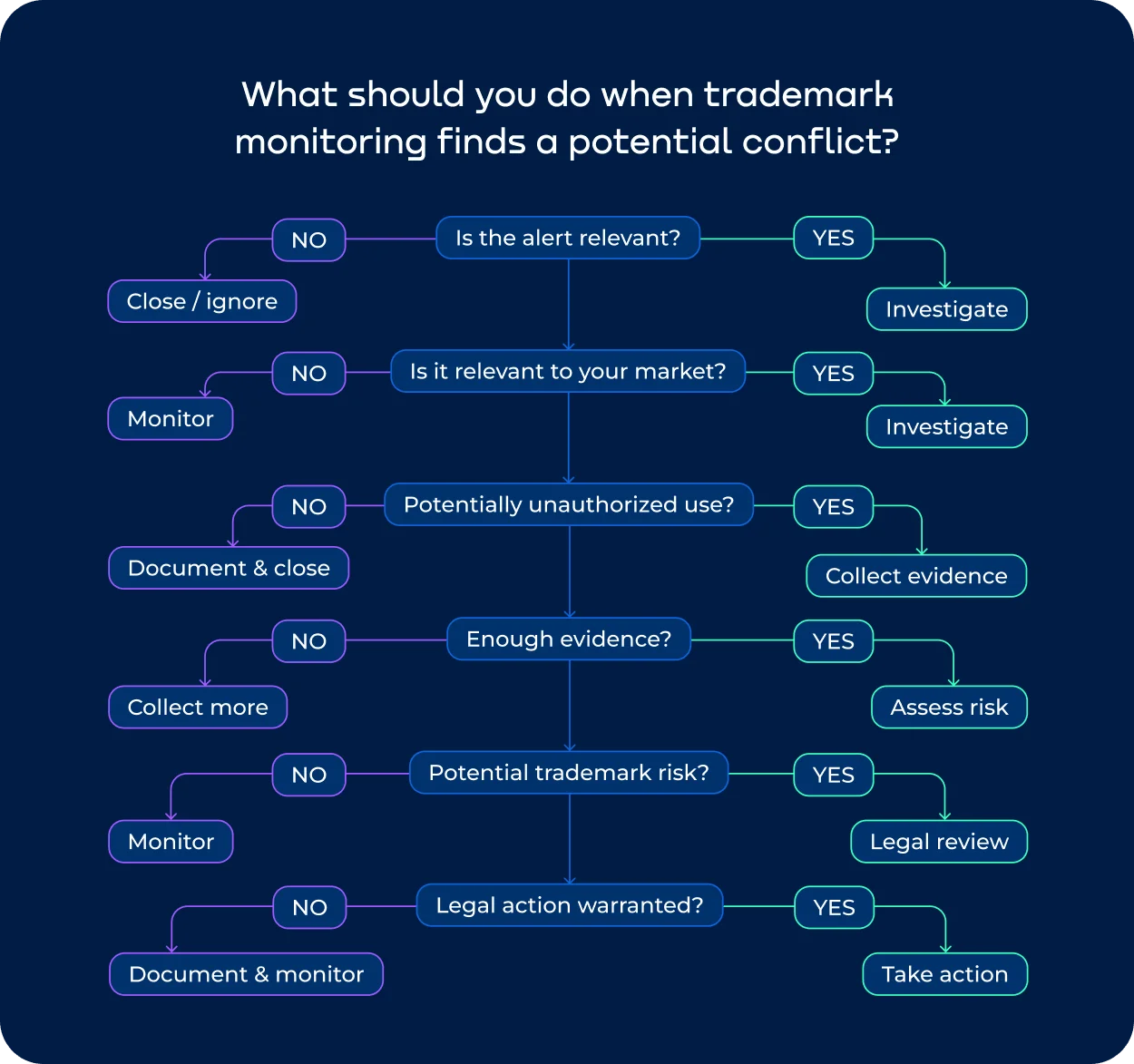
A trademark alert is not a legal conclusion. It is a lead that needs to be verified, contextualized, and — when warranted — escalated.
A practical response workflow looks like this:
- 1. Verify the result. Start with the source. Confirm that the core details — mark, application, owner, and other — are accurate. Automated trademark monitoring tools may surface candidates quickly, but every alert needs to be checked against the underlying record.
- 2. Check status. Find out whether the mark is a new application, pending, registered, abandoned, cancelled, or otherwise inactive. Status changes the urgency as well as the available response options.
- 3. Compare the marks. Look beyond exact spelling. Compare the visual appearance, pronunciation, wording, meaning, and overall commercial impression.
- 4. Review the goods and services. Two similar marks do not automatically create a conflict. Examine what each mark covers and whether the goods or services overlap or are commercially related. This is where the relevant Nice classes are especially useful.
- 5. Check the jurisdictions. Confirm where the potentially conflicting mark is filed or used and compare that with your own trademark rights and business footprint. A potential conflict in a core market deserves more attention than an otherwise similar mark in a jurisdiction where the brand has no rights, customers, or expansion plans.
- 6. Document the evidence. Keep the original record, screenshots, URLs, filing information, dates, and other relevant evidence. Good documentation saves time later — particularly if the case eventually moves from monitoring to enforcement.
- 7. Assess the commercial context. Context can turn a seemingly minor alert into a priority case — or explain why an alert can safely be closed.
- 8. Send relevant cases to trademark counsel. Once an alert has enough evidence and commercial relevance, involve the appropriate legal or IP team.
- 9. Track the outcome. Record whether the case was dismissed or escalated further. This helps in case of recurring patterns.
How is Trademark Monitoring in the US Different from International Monitoring?
Trademark monitoring in the US requires coverage of the USPTO, while international monitoring usually requires multiple national, regional, and international sources.
The reason is simple: a registration generally protects a mark within a particular jurisdiction.
For trademark monitoring in the US, the USPTO is the essential source for federal applications and registrations. Its trademark search system covers active and inactive federal records. It allows searching for not just exact matches, but also confusingly similar marks based on appearance, sound, meaning, and overall commercial impression.
A business expanding from the US into Germany, France, and the UK needs a somewhat different monitoring map. An international e-commerce business may need several national registers, EU-level sources, WIPO databases, and monitoring of actual online use.
Conclusion: Is Trademark Monitoring Service Worth It?
If your brand operates in several markets, has a valuable trademark portfolio, works through partners or affiliates, or relies heavily on digital channels, waiting until someone finds a conflict by accident is an expensive approach.
Continuous trademark monitoring can provide earlier visibility into potential conflicts and unauthorized use of assets. A well-designed process gives your team enough time for decision-making and action.
If you want to see how brand monitoring can extend beyond trademark registers into search, advertising, affiliates, and other digital channels, explore Bluepear's trademark monitoring software: free trial is available → here.
FAQ
Should you use trademark monitoring software or manual searches?
Manual searches can work for a small portfolio or occasional checks. They become difficult to scale when you need to monitor multiple marks, jurisdictions, languages, or channels on a recurring basis.
Trademark monitoring software can automate recurring searches, similarity checks, filtering, and alerts.
How often should you monitor trademarks?
There is no universal frequency.
For active brands operating in competitive markets, frequent scans are generally more useful than occasional manual searches. The more important point is consistency: a search performed once a year is not going to achieve anything.
How do you choose the best trademark monitoring service?
Check which jurisdictions and databases the service actually monitors, how it handles similar marks and false positives, how frequently it updates results, and what kind of evidence it provides.
Then look for tools that track unauthorized use in digital channels. Monitoring only applications may leave a significant layer invisible.
The best trademark monitoring service is the one that matches your actual risk surface — and helps your team turn detection into a documented, actionable response.
What is the difference between trademark monitoring and trademark infringement monitoring?
Trademark monitoring identifies potentially relevant activity; infringement assessment determines whether that activity actually violates trademark rights.

Monitor your brand in search engines